I’ve found there have been an unusual amount of visitors lately, which is delightful and I’m very grateful! And I’m sorry there’s not much here that’s new.
Historically, I’ve been largely writing into the void. I took a long break from any writing at all—a break that spanned years, some of them quite difficult. As I’ve returned to writing, this site has been pretty quiet and the unfortunate consequence of this is that it got sidelined in favor of other backed-up projects.
The return to writing – mainly pertaining to the characters in my fantasy mythos but other things as well – was either the trigger for my bipolar episodes to resume or the reaction to their theatrical resurgence. Honestly, I’m still trying to figure this one out.
I missed the guys so much, especially Rushak. Once they reappeared, I was both overjoyed and apprehensive. And they brought friends! With weird symbionts! I just can’t trust my psyche. I didn’t know what was going to happen. Hypomania, crushing depression, paranoia … It’s effin’ rocky. Now that I’ve got years behind me, I understand stuff, though, and am piecing together what it means.
There are aspects of this journey I very much want to share in the hope they might resonate and offer comfort, ideas or help of some kind.
I have a lot of ideas brewing once more, challenges and solutions to explore, and I will be throwing a lot more effort into posting material with relevance and at least a semblance of consistency.
Upcoming topics:
Fear of failure
Victory
And probably related fiction and/or poetry (oh joy)
So, thank for visiting, for being here, and I hope to see you again.
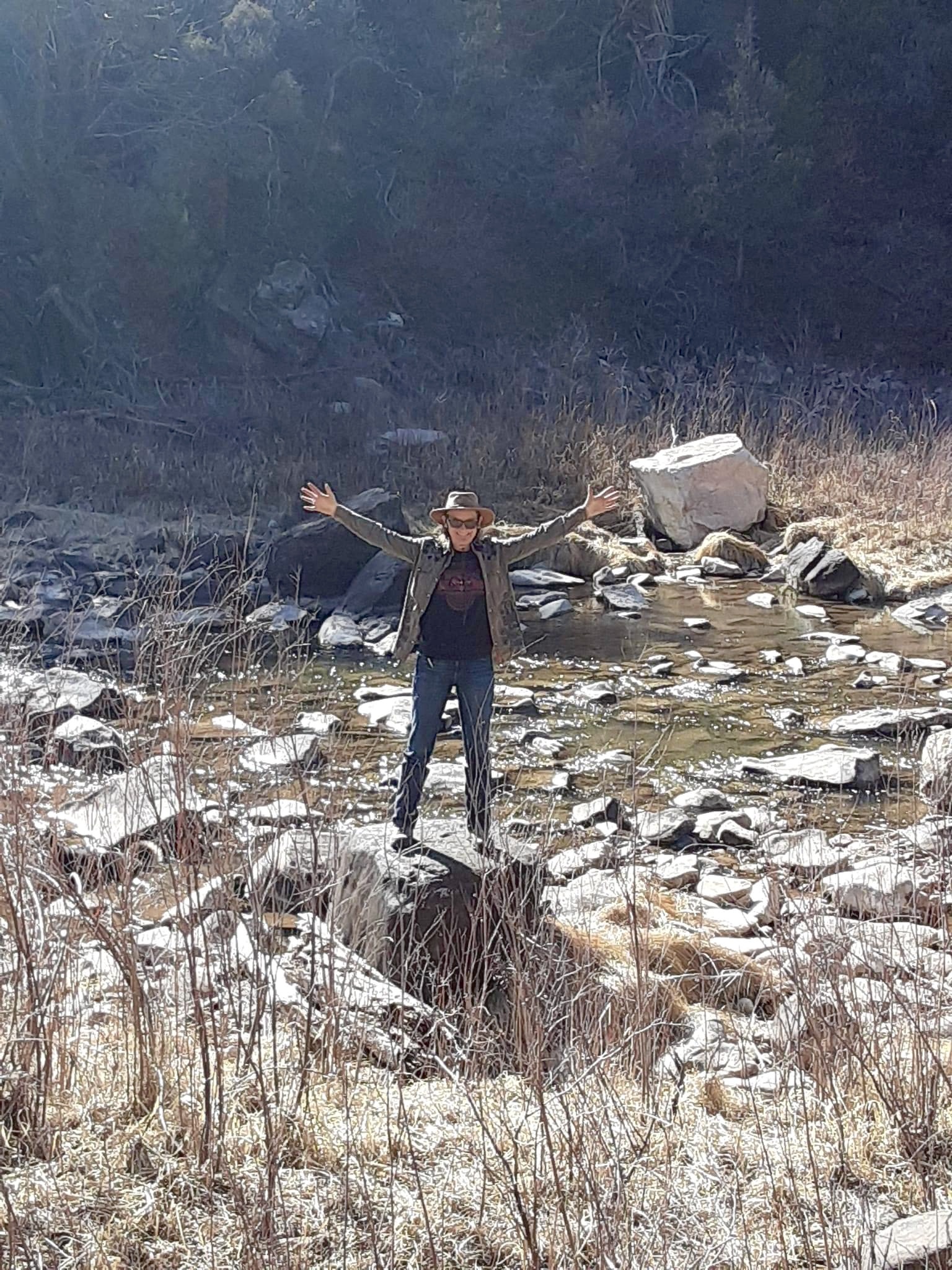
The Gold Run Bridge is eight rigorous miles from the highway. The trail consists of steep climbs, rocky passages, creek crossings, close, narrow tracks alongside the roiling whitewater, and precipice-edged climbs leading far above Bear Creek, a distant strip of white, blue or brown, depending on the season. It winds along the mountainside, in and out of forest and exposure. It feels like an epic journey, culminated with a descent to a grassy meadow, a campfire ring, and fishing protocol.
The bridge crosses Bear Creek in a gentle arc. Step off, and Gold Run Trail tugs you onward. Its effortful, steep ascent makes trivial all that has come before, where fire has opened wildflowers to the sky and scree fields cascade downslope like a vast gray river of stone across your path. Two mighty trails, two fragments of the Colorado mountains’ healing soul.
What comes first, I don’t know. Depression from helplessness, or helplessness from depression; I think there are arguments for both.
First off, I’m not a psychologist, and have no academic qualifications to address any psychological disorder. I haven’t done extensive research and have no scholarly citations to list at the end of this. I do not claim to have the empirically correct solution. I’m just here to share things that, through trial and error, ended up working for me after I lost practically everything to bipolar 1 mania and depression, and I learned helplessness.
When bad things that are out of your control keep happening to you, you eventually come to believe that things cannot get better and there’s nothing you can do to improve your situation or your outcome. Whatever you try leads to no escape and that is the law of your life.
People with learned helplessness lose their motivation, and just get washed along with the current, expecting they will end up in the swamp or the quicksand and sink. There is no point in trying to save themselves. They become hopeless, and even anticipate more bad things. Helplessess is the law of their life.
“Let go of what you can’t control and choose to be positive” is not a helpful piece of advice to someone in this state, so you just have to blow off people who scorn you for not being able to do it.
This quote (somebody threw in my face) from the Greek Stoic philosopher Epictetus is what got me to pondering on helplessness:
“Freedom is the only worthy goal in life. It is won by disregarding things that lie beyond our control.”
Okay. If you buy this, it looks like to win freedom from whatever, you just choose to ignore the things you can’t control, because if you disregard the things, they can’t control you. But it’s not that simple if you’re in a morass of learned helplessness and depression.
Don’t you at least have to acknowledge the things that are beyond your control? Will it really help you, avoiding thinking them over? What is actually going on? Is there a cause? If the cause is something you can’t control, ignoring that cause isn’t going to keep it from controlling you. Looking at it is the only way to begin to understand it.
To find freedom you must first accept the feeling or circumstance. Ignoring is just a way to put off acceptance, and therefore the power of change. One day, look at the circumstance objectively, and look at everything surrounding that one uncontrollable situation. Look at how it is affecting you. This can lead you to find something to change about yourself. Find something you can control. You can’t do that by disregarding the thing you can’t control.
Once you acknowledge and accept the thing that is out of your control, you can move toward finding a strategy to empower yourself.
Steps to self-empowerment:
They say you can control your attitude. Just snap your fingers and CHOOSE to be positive!
Okay, well, that doesn’t work for everyone. I suggest mindfulness as a starting point.
Mindfulness helps you to ground yourself in the moment. Feel the surface under your hand. What do you hear, see, smell? Label it. Describe everything to yourself. Even if you have to actually slam your hand down on the table and say “table!” Knowing where you are and what is around you is the beginning of control. It’s the beginning of viewing yourself and events objectively.
Your approach to the circumstances. Consider approaching the challenges differently (or at all).
One way is to try looking at your situation as containing a problem to be solved. You can make a shift from helpless complacency to being solution-oriented. This doesn’t mean you can control an uncontrollable circumstance such as weather or how someone else is acting, but you may have control over an effect or two on your environment or your frazzled brain. If you can’t spring immediately into a positive attitude toward things, still you can choose what action you take. If you can pick up one little aspect of your life and improve it, do it, and be mindful of that improvement, even if it’s just managing a smile or putting away a cup. Don’t belittle it or yourself. Don’t feel you have to put more effort into it than you can at the moment. As you get stronger, you’ll be able to put more effort in, and your attitude will improve. One little step at a time, you can progress into a solution-oriented attitude by focusing on those tiny adjustments, the things you can control.
Don’t forget to take care of yourself. Prioritize your physical and mental health.
This is another big topic in and of itself. You can’t take care of the helplessness as effectively if you don’t take care of yourself. The hardest thing can be taking the time for it. If you’re not in the habit of taking care of yourself, it’s looking like another big, overwhelming project. It doesn’t mean you have to embrace diet, fitness, sleep, and social time. You can find one thing at a time to improve. You might break it down, make a list, choose the first small thing you can do for your health that you haven’t taken the time to do.
Allow people to help you.
This is a tough one for some people, independence, bootstraps and all that. You can choose to accept help or not. But if you can’t accept help, you could be making the hill you must climb that much higher and steeper. I have little to contribute to the general idea, because it was difficult for me, but I know I usually made things a lot more difficult when I refused help.
Attend to relationships.
Do your best to nurture what you have with family, friends, coworkers. Find ways to reach out. Let them know they are loved and appreciated. Examine those relationships (objectively, as above, if problematic) and work on improving them in any way that is relevant to your situation.
A personal story of how I empowered myself
During a time of poverty that seemed so hopeless that I lost all motivation to care for myself or my surroundings, I got into the danger zone. My husband couldn’t find work, and when he did his clients took advantage of him. I was disabled due to severe bipolar episodes. I felt helpless to fight the disease. And I was sure we were destined to lose our home. There was no point in cleaning house, because it was too overwhelming. There was only so much we could do to maintain the place with no money, despite my husband’s skills. Furniture was left outside, and though I didn’t want it there, it was there, so there was nothing to be done about it. There was no point in trying to communicate with my family, because I was a bad mother, a worse wife, and there was no understanding between us. And so on. Little things and big things sticking together and rolling along, into a boulder of hopelessness. I was helpless. I knew I was powerless to effect any positive outcome, so I didn’t try.
One day I looked at a table that had been left outside, and it was damaged, and for some reason I picked it up and moved it. I have no words to describe what a big achievement that was. But that was the beginning. I learned that it didn’t have to stay where it was. Yes, it was neglected, but just because it was outside did not mean it was already too late for it. I could stop further damage because I had the power to move it. Wow.
It was not the thing that lifted us out of poverty, but it was an event that began my slow journey out of helplessness, which eventually became part of the greater process of ending the poverty. Despite the large proportion of circumstances that were out of my control, there were things that could be controlled, and it was a matter of teaching myself that I had the power to control them. Somehow, over time, one teeny thing after another, I able-ized myself.
It’s finally over. February. Having worked its foul, soul-crushing necromancy, as February always does, springlike weather notwithstanding, and launched me into March madness. Let the rapid cycling commence: Mania’s mental modifications to depression’s non-functionality, swapping every 24-72 hours, despite medication adjustments.
So … writing with bipolar. It seldom ends well for the characters. Pain and creativity go hand-in-hand with us, and we’re navigating these talus field crossings as best we can, but the process can be difficult. The main character/protagonist becomes the whipping being for all the angst their creator would otherwise expend upon herself. (Not that there isn’t plenty of damage left to be done once MC’s wrung out.)
The main thing I feel during rapid cycling is helplessness. The creative outlet for this is the writing, the story, my suffering hero, Rushak. He is swept along through the tempest, up, down and through, as my moods carry him (given the opportunity to write). My feelings of helplessness during these times are the main contributors to his lack of agency at various points in the story. Rush makes a decisive move, and lands afterward in a place of helplessness, and has a terrible floundering time getting out of it alone, if he even can. In an alternative universe, on a separate world, Lohar abides. He usually dies.
Hail to the suffering hero. Depression or mixed state is the time of his great helplessness, whether the scenes will end up in the book or not. If there is violence in me it will be wreaked upon him, or result in self-harm. Without him, I’m not certain I’d be alive.
January is Mental Wellness Month, and also this month, it’s expected we welcome the new year with resolutions and then at least pretend to try to enact them. Resolutions can be thought of as promises to make personal change for the better, so it’s a perfect time to focus on mental well-being.
One of the biggest things we can do for ourselves is get regular exercise, right? The National Institute of Health says that just 30 minutes a day of mere walking can improve mood, reduce stress and, of course, provide a host of health benefits. Taking that walk in natural sunlight will even help us connect with that elusive unicorn known as “sleep.”
In the winter, especially, enjoying what sunlight is available is an important component of managing depression and mood swings, bipolar and otherwise.
I don’t know about you, but for me it’s so hard to get out when I’m depressed. Nice, helpful articles with bullet points generally have “Participate in favorite activities,” “Go out in nature,” and “Get enough sleep,” in them. But uh, it’s gray outside, it’s cold, I feel shitty, there’s no snow, I have to work tomorrow, everyone hates me, I hate everything, I can’t get enough sleep ’cause reasons, and, oh yeah, what “favorite activities?” Are you storming kidding me?
My modus operandi is to take a plan, any plan, and find one good excuse to jettison it so I can go sit and not write and stare at the dusty piano and feel sorry for myself.
So, in the name of self-preservation, it’s time to force myself to help myself against my will. Does this sound familiar? It’s sooooo hard! Exercise and sunlight are the topics for this Sunday, and a wan, winter sunlight it will be. How to get there:
I have learned to mechanically program my body to do the things to prepare for the activity, “just in case I change my mind.” Perform tasks, be the automaton, just like at work. Task A, B, C. Miserably put on clothes, drink coffee, eat breakfast, doggedly put on shoes and tie laces in spite of cat helping, and then … the danger point … go back to pee and look for phone.
Once past that, shove the body out of the door with will alone, and … outside. Having someone pushing helps.
I’m still depressed, though, and not having fun, because I’m depressed, and depression is tenacious as a headache. But you know what? Feeling the warmth on my face, the light on my eyelids, watching the solid tranquility of twisted junipers with the breeze whishing through them, hearing good music or clattering freight trains … I’m not enjoying it. I don’t want to be here … the energy is just soaking into the body and brain without me. The sights, sounds, and smells are ambling right in through the eyes, ears, and nose into the “animal hindbrain.” I think about that objectively, how I’m mad, but that’s not stopping the sunlight from penetrating or the images of my surroundings from imprinting themselves.
This involuntary absorption of healing influences is a thing. It will do its job. Going outside for sun and exercise does result in reduced stress, stabilized or elevated mood, increased energy, and better sleep. But yes, sometimes, it has to be forced.






 Siege of the Spirit