Skip navigation

I started this blog a long time ago when I was very depressed and upset, with no clear idea what I wanted to do with it.  Just bitch to the world about how much it sucks to have bipolar disorder?  What good is that?  No good, no good at all.  I know there are resources out there.  I took Dialectical Behavioral Therapy and learned lots of great skills.  There’s a weekly post-DBT meeting I could be going to if I could stand to leave the house.

I read a friend’s blog recently, a new one she’d started that was intended to provide a service to its readers.  She admitted starting the blog was scary, was concerned about making mistakes, but was going to try it anyhow.  Part of me wanted this blog to do that, too, provide a service to readers.  My friend’s an artist, and her courage got me to thinking that I should go ahead and try this again.

But who the heck to reach out to?  Because of other social/work connections, I don’t want “just anyone” reading this blog, which raises the question why do it at all?  At this time, no one reads it, so it doesn’t matter.

I could start with what I’m taking: Nighttime meds (Seroquel 100 mg, Mirtazapine, Clonazepam), and Daytime meds (Lamotrigine 150 mg, Clonazepam), for bipolar disorder and anxiety.

Yesterday I added 10 mg amitriptyline at bedtime.  This was not for depression, although it’s an antidepressant.  It was prescribed to me for migraine prevention by a neurologist over a week ago, but I wouldn’t start it until getting the ok from my psych doctor. All I need is for a new antidepressant added to everything else to exacerbate my problems and the side effects of the medications through interaction. But the the psych doc finally gave the ok, because the dose is so low.

Today I woke up late, from unpleasant dreams I could not seem to get clear of, with a migraine starting. So I took Excedrin Migraine with my am meds.  Once up I had to hurry hurry hurry and was really cheerful, which is unusual for the early morning.  I thought perhaps the amitriptyline had a positive effect?  After I got back from dropping off the kids at the bus stop, the aura started up again, and I got really dizzy and felt like I was going to pass out.  The feeling lasted a long time and seemed to be getting worse.  I kept on with feeding the horses anyway, wondering if I would just drop dead.  I had to stay out there and keep an eye on the horses.  I was so worried about each and every one.  My solicitude is purely anxiety-driven.  I have no identifiable reason to think I need to worry about any of them.

Ever since R, my favorite rescue horse, died on Jan. 21, I’ve been unable see beauty when I look at the horses.  All I can see out there is a herd of potentially dead animals.  And every management decision, whether to turn this one out, bring that one in, feed grass hay or wheat hay, has become a huge, nail-biting dilemma.  It’s paralyzing.  This has happened to me on every occasion a horse in my life has passed away.  It was especially bad with T, last April.  I had planned to bring her in the previous night but didn’t.  Before morning, the freak accident had occurred with the fence wire, that ultimately cost her life, after weeks of round-the-clock care and involving four veterinarians with different ideas and approaches.  And that last morning, she made it perfectly clear that she did not WANT to be euthanized, even though she was suffering and crippled, which made the euthanasia even harder.

R went in his own time, comfortably, from old age and not from an accident.  For the first time, I haven’t second-guessed myself or found anything to blame myself for about a creature’s life or death.  Despite this, I don’t know if doing the horse rescue is worth it any more.  I can’t keep going through this.  I need someone to talk to about it.  But who?????  Who in rescue or the horse business can I discuss these feelings with without fear of being judged???  “Weighed, measured, and found wanting”?!

And am I just being paranoid?  How big a role is my bipolar disorder playing in my view of how others view me?  I have to assume it’s playing some role.  A significant other in my life always (yes, the correct word is, in fact, “always”) tells me my worries are “ridiculous”, “silly”, or “stupid”, and not to talk to anyone about them.  This is extremely unhelpful for me.

I am working on letting this person’s words roll off my back, and also trying not to voice my worries when this person is around.  After all, I know my worries aren’t stupid.  My inner compass is still true, even if my steering is imperfect!

Suicidal State of Mind

The idea of the suicidal state of mind is fraught with controversy and contradiction.

From the outside, it is viewed as “crazy”; “attention seeking” (if shared with others); a “cry for help”; “selfish” (if carried through); “tragic”; and makes friends and loved ones feel helpless.

From the inside, it can be all these things as well. But there are many more things going on, as anyone knows who has truly experienced a suicidal state that goes beyond ideation.

Strategies for the suicidal

These strategies worked for me. They are offered as a way out for the severely depressed, cornered, isolated, helpless person on the brink of suicide. They are mind exercises that you can go through as a checklist, even if you don’t feel like it; it will force you to think, despite what you are feeling.

1. It is certain that this state of mind WILL come to an end if I do not act. Then, I will be glad I did not act.

2. Think of anyone or anything I have a responsibility to.  Examples might be:
Spouse
Children
Pets
Work
A cause I believe in
A project close to my heart that I want to finish

Problems concerning some of these might be the very things that triggered my depression, so I must make an effort not to focus on them. It is very difficult to consider others because of this black whirlpool that has tightened around me. But what might happen to my people, causes or projects if I am gone? Despite what I think right now, I AM needed.

3. How would I feel if my significant other committed suicide, or was killed, leaving ME with the responsibility for everything? I would be overwhelmed. Do I really want to do that to someone else?

4. Think of my achievements, pleasant or rewarding activities, milestones I have witnessed in my children’s lives, etc. that I would have missed if I had succumbed to a previous suicidal episode. Many more of these experiences lie before me.

5. Remember how I got through the previous suicidal episode.

6. Let self-interest work for me. What would happen to me if I attempted suicide and was unsuccessful? What and who do I have to lose in life afterward if I fail?

7. The idea of God and an afterlife requires faith. What do I believe in? Is suicide a sin? Do I believe I would end up in heaven, or hell?

8. The idea that there is no God, and there is only blessed nothing after death, also requires faith. No one knows what lies beyond that barrier. There’s no proof that I will attain freedom or relief from my torment. There are plenty of other possibilities. After committing suicide, my soul could end up trapped forever in the exact same state of torment as it was in when I died. For forever, no release.

9. Write, draw, or play it out. Meaning, write my thoughts down, even if only to burn them later. Or, draw/paint/sculpt whatever my hands will do. Or, if I am musical, play whatever comes out. If I enjoy cooking, cook something. This is cathartic and provides relief.

10. Pray or meditate or practice EFT or other mental strategies.

11. Escape into movies or books. Take to my bed and make no apologies for it. I have arrived at my current state through unbearable stresses and I am entitled to take a break.

12. Escape through exercise, a walk in a pleasant park, the woods.

13. Care for animals. Pet my dog or cat, groom my horse, get a fish.

14. Consider the possibility that I am under the influence of someone or something else, and that this horrid thing I hate is not really ME. Direct my self-hatred toward that influence instead, and banish it through prayer, intention, or whatever else I believe will work.

15. Think about tomorrow. The sun will rise just the same, and I may wake up feeling completely different than I do now. Each day is a fresh start.

I hope this can help me in the future, or help someone else.

Don’t get me wrong. It is late November, and at this moment, I’m despairing. The state that, without fail, evokes the urge to write, and the urge to pray.

However, exhausted from caring for rescue horses and drowning under horrid decisions, unfortunate news to deliver, the impossibility of solitude, the loss of youth, and the probable loss of the only draft of my novel’s first chapter that I will ever have found “perfect,” I have indulged in my first-ever Vodka Binge.

The Lord, and my family, deserve better.

I am LUCKY AND BLESSED to have a FAMILY! I am blessed to have a home. Of course I know this! It’s crazy lucky, and could only be the result of God’s direct intervention. My husband is the hero in this tale, for reclaiming a crazy bipolar freak who had done him every imaginable wrong during a prolonged psychotic episode.

But this used to be my house.

There were candles on my upright piano, and the occasional wine glass left there too beside the sheaf of hand-written music, the residue of petite sirah, scent of blackberry and cloves, dried into the little hollow where the hand-blown stem opens out into a pink blossom of glass

There were shelves lining the walls, with my books, a mad eclectic mixture of fantasy, history, witchcraft, Bibles and Biblical texts, psychology, poetry, all the weird fiction I was assigned to read in college, wildflower books, the Irish language, and guitar chorded music books, Led Zeppelin, Kate Wolf. My Breyer Horse collection circled the living room, right below the ceiling. My childhood remained a vital piece as I approached thirty, and I didn’t want anyone to know me who didn’t understand that. My small circle of friends knew, and made me feel that they thought it was cool.

There was a room with a Macintosh Classic II, the place where I worked on my novel and my art, where the pages were spread all over the floor, the illustrations the most raw, and Rushak’s presence was so strong I could feel and smell him in there as if he were real. Mom sent him a birthday card one year. Oct. 8. It was the coolest birthday card I would ever receive.

KRWN (Farmington, NM) was a classic rock station then. I could hear Elton John’s “Funeral for a Friend.” I could hear “Green Grass and High Tides” by…Ozark Mountain Daredevils? I had a boom box on a shelf over my Asian-patterned rug. There were “tapestries” on the wall. Neo-hippie crap.

I had the most awesome roommate for a time. He had become a high school English teacher (there is no higher calling). He loved Kurt Vonnegut. In this house, there was a shrine erected to Kurtz (of Joseph Conrad’s Heart of Darkness and the movie Apocalypse Now)  every Samhain (Day of the Dead) for reasons that escape me at this moment, but they made perfect sense to my roomie, may he rest in peace. He was privileged to smell the most epic of my farts, after which I collapsed from some sort of interaction from my various meds, and he took me to the hospital in the middle of the night.

There were guitars and pennywhistles and drums and pianos and keyboards everywhere. There were charcoal and pen-and-ink and watercolor illustrations of my novel on the walls in the kitchen and living room, right were everyone could see them, vibrant and slightly “off,” personal and disturbing, and I wanted people to see them, and they did, and I felt a little bit understood.

It smelled like incense in my house, and candles. My mom once said it smelled like a candle shop. That was the highest praise anyone could give my home, for in Ridgefield, Connecticut, in the seventies, the Candle Shop was the most magical place in the entire universe. Even counting the occasional visit to a horse farm.

I lived alone, except for the brief time with the roommate. There was one cat, two dogs, a horse and a burro, who all depended upon a bipolar creative type stuck in her right brain most of the time. No one minded.

Mainly, there was no TV in my house. (Well there was, okay, a little b&w with a screen smaller than this Mac notebook’s, which was only used for viewings of classic Star Trek). My mom gave it to me when I started college at the U of U.

My point is that I used to have this house…it was a shoebox that had been for some reason picked up off an oil or coal or some crap field in NM and plonked down right here…and I lived in it, and it was mine, and I had a sense of place.

Now, ALL my books are crammed into a closet of an “office” that my husband had once blocked off and constructed to be my creative space…the ONE thing he could do to show me he supported this part of me…NONE of my paintings, charcoals, or any other art besides a picture of a rescue horse are visible to anyone…NONE of my books or bookshelves remain outside this office…ALL the spaces that friends and the general populace can see are cluttered with dirty shoes and boots and stacked with crap…the house smells like several catboxes…a dog pack lives here and craps on the floor and tracks mud all over and the cats and dogs ruin the furniture…I CANNOT play an instrument if anyone is at home…ALL of my instruments are hidden away…I no longer have time or the self-esteem to be in a band…I no longer read, because there is NO ONE with whom to discuss anything I have read…I no longer read because I have no bedroom or quiet area that will not be disturbed in which to read without a TV blaring or children arguing…I no longer write because my writing studio has become the office in which I must update the Horse Rescue Blog, or enter Horse Rescue stats, or check Horse Rescue Email, or drop any personal pursuit in favor of Horse Rescue outreach or finances, and the only computer in here, a Macintosh, now belongs to the horse rescue, not to me.

The only draft of my novel’s first chapter that I found perfect was not backed up in time to avoid being a casualty of the Blue Screen of Death on my Windows computer. I know it’s my own fault, it wasn’t backed up, but who has time to try to put a bunch of crap on a disk on a computer whose disk drive doesn’t work?  It’s me, the person who cannot sit at a computer and enter statistics and generate receipts and acknowledgements and updates and health data on a double-digit number of needy horses; actually, physically care for them; and be there for kids and husband. Let alone, self.

Fortunately, no one reads this crap. I’ve gotten steadily drunker as I’ve rambled here. I’d be done long ago except that no one could read this because of the typos. There is a tremendous amount of back spacing involved.

I feel like throwing up. There is nothing to look at but my nerveless fingers upon my jeans stained with the filth of about a week of mucking stalls, I can’t think about anything but how crappy I feel. If there was ever a point to this post, I’ve forgotten what it was, except that once I had a home that was mine, and now there is nowhere in this overgrown building that I can feel safe with my feelings, that is, my real, honest, own feelings, that are mine, where I can think clearly and create write and practice.  There is no refuge anywhere. I used to be able to at least write, even though the lofty elite authors and artists and poets of Southwest Colorado LITERATURE don’t consider my genre or my work to be of any value…. but now… nothing.

I feel no sense of place. I know that eventually this feeling, like all feelings, will be replaced.


Today I thanked God for my bipolar disorder.
I thank God because since I have this thing, it means I was meant to, and I thank Him for the lessons it has taught me, and for the lessons I will continue to learn.
And I thank God for taking away my bitterness over it and replacing that bitterness with gratitude, at least for today.

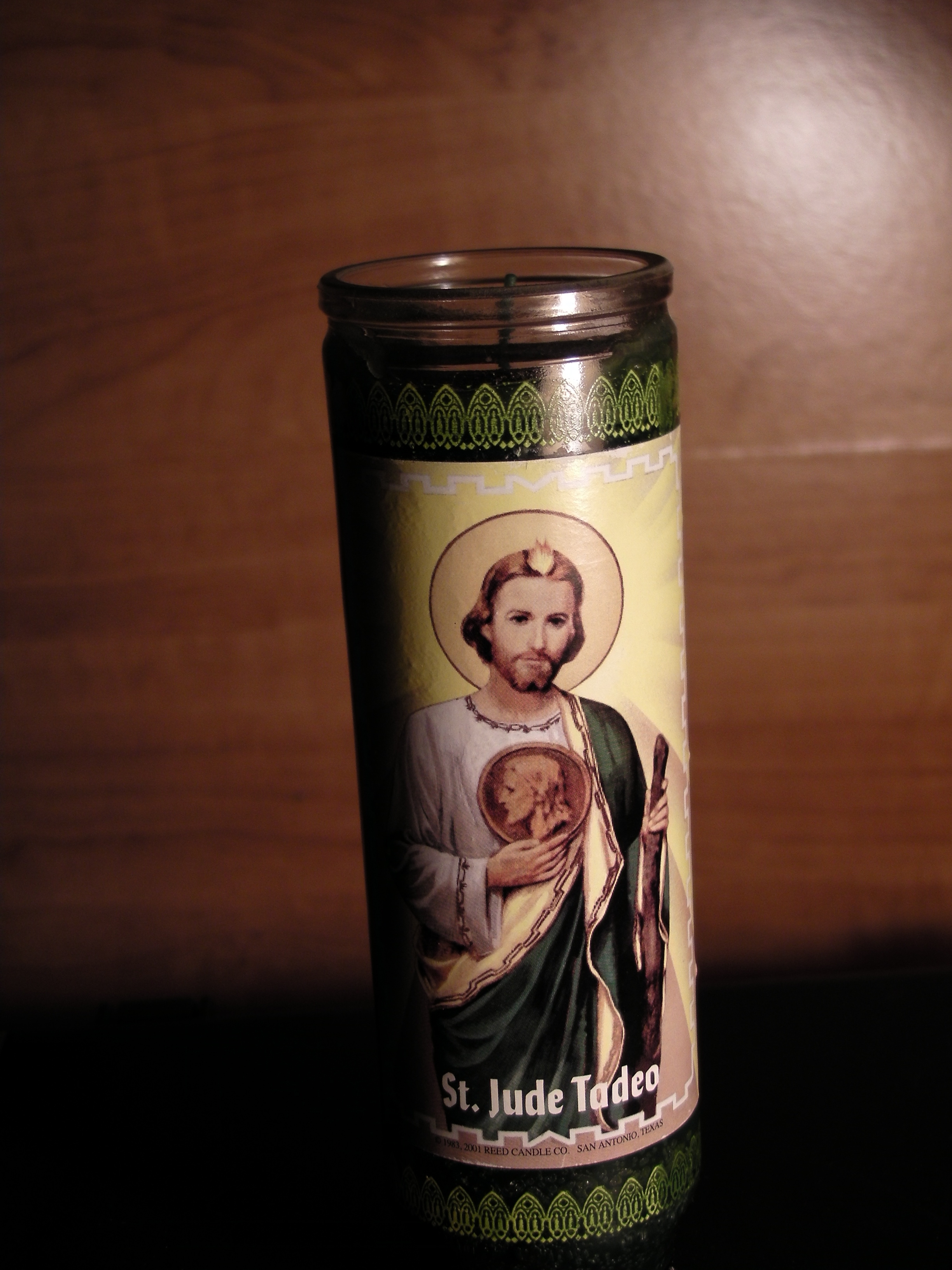
St. Jude candle

“I was named for the Saint of Lost Causes. It’s true. You can look it up.”

That’s what one of my long-lost half brothers told me many years ago, and I thought it was cool. It fit in with my insanity so perfectly, and I envied him. At the time, I was clinically psychotic.

Here’s the prayer on the pretty St. Jude Tadeo candle I bought at the dollar store.

“Most holy apostle, St. Jude, Faithful Servant and Friend of Jesus, Patron of Hopeless Cases, of Things Almost Despaired Of, pray for me. I am so helpless and alone. Make use I implore you, of that particular privilege given to you to bring visible and speedy help where help is almost despaired of. I promise to be ever mindful of this great favor, to always honor you as my special and powerful patron. Amen.”

Actually, that’s a pretty good prayer.

All of us at one time or another feel like this. I often like to think we bipolar people feel these sorts of things more keenly…maybe “we” do and maybe “we” don’t. I don’t, can’t, presume to speak for any person living in bipolar other than myself, and I am very aware of my tendency to elevate my condition to an epic sort of stature, knowing full well that it’s no more epic than a host of other conditions, mental and physical.

There are a lot of good words in the St. Jude prayer.

Today, since I’m in a more healthy frame of mind than I was when I made the first post, I shall latch on to the most helpful word: Mindful.

Mindfulness is the core skill taught in Dialectical Behavioral Therapy. DBT was created for Borderline Personality Disorder, but it teaches a skill set that is helpful to all. All skills in DBT come back to this one core skill, being Mindful.

What does mindfulness mean? I can only tell you what mindfulness means to me.

It means being fully present in your mind, body, emotions and environment. It is a means of grounding oneself and finding rest inside the turmoil. It means pulling back and acknowledging your feeling and accepting it without judging it. It’s not a good feeling or a bad one, not right or wrong, no matter how strong it is: It is what it is, nothing more or less.

Say that I feel anxious. I also feel the chair against my body, the responsive keys under my fingertips, and I hear the keys clicking and the rain and thunder outside. I concentrate on these things, allowing the feeling to exist but not allowing it to take over, or to represent things that cannot be helped or may be “despaired of.” Rather than allowing the anxiety to direct me to worry over whether there will be a job for my husband, or dwell on the fear that a horse will colic, or obsess that posting this stupid blog caused people to un-friend me on Facebook, I simply accept the feelings of anxiety as I accept the smell of the rain and the wet dog under my desk. I am Mindful.  And the anxiety feelings often will slip away.

There is also a technique of breathing, which is pretty much the same as any relaxation technique of breathing, I think. You breathe deep, and concentrate on it, and you let the thoughts in your head be there and go on their way, without judging them or berating yourself for having thoughts.

Hypocritical Quandaries

I am still not sure what I am trying to accomplish with this blog. I certainly don’t intend for it to be a vent for negative feelings, though that is what started it. I am sure the good people at the National Alliance on Mental Illness would not look approvingly on my previous post, although I stand by it as expressing a valid point-of-view, that is, one point-of-view among multitudes.

For those who might wonder, yes, I have dealt with cancer. More than one member of my family has battled it. Not me personally. But I live with chronic, often debilitating pain, and I have experienced at least part of my share of pain so severe that hospital medication is inadequate to assuage it.

More troubling to me is that after all that spouting off about the injustice of being misunderstood and stigmatized for a mental disequilibrium, I find myself on the other side of the river! I wish to cut all ties with someone because of that person’s behavior, and I know that behavior is at least partly the result of the heinous bipolar mania that the person is currently trapped in. What a hell for this individual, and me over here a freakin’ hypocrite.

I want to help the person, and the person does not appear to be managing the condition responsibly. I, who should know how to help, can’t figure out what I should say or do. Whatever it is would be proactive on my part, because the person in question doesn’t call me and isn’t really that big a part of my life. Maybe I am questioning whether it’s my place to jump in. Maybe this person has a support system of friends and doesn’t need me.

But I expect this individual is suffering alone, alone as I was, because except for a very few exceptional people, no one wants to be around a person acting like this unless they are paying them money. This individual is pushing people out of connection, whether intentionally or not. I can relate to this person. Oh, can I! But there are certain attitudes I do not want to enable by agreeing with them.

I do appreciate the quandary my manic depressive episodes place people in. Most of the people avoiding me during the worst of it did not have the tools and perspective that I have, so how can I blame them for jettisoning me, if I can’t figure out what to do here and now?

Well, until I work it out, I can pray.

Most Holy Apostle St. Jude…

Choice, responsibility, and survival: Living in Bipolar One

What does it mean to be in bipolar disorder?

No one knows except a person who is in it.
For some people, it is a challenge to be bravely met and survived. For others, it is impossible to live with. For me, it has continued to be both, for decades.

Everyone’s experience of mental illness is different, because the disease is in the brain, where our personalities, thoughts and emotions reside, unique to every one of God’s children. The following observations describe some negative aspects: some difficult challenges and stigmas associated with people suffering from bipolar disorder. They are based on my personal experience of this illness, and what I’ve witnessed happen to others who dwell or once dwelt in it.

Everyone has moods. Everyone has their ups and downs, their times when they are at their best, and their times when they just can’t be the “Me I Am Proud To Be.” Everyone suffers from lapses and embarrassment, everyone struggles to become more mature, more self-confident, and more socially aware. This is just as true of individuals in bipolar disorder; and though our ups and downs, our successes and failures and phobias, and our inevitable periods of self-involvement can be more pronounced, we strive for self-improvement, to be positive, upbeat, mature compassionate, and wise, as much as anyone can.

My Cancer Analogy

Like cancer patients, bipolar sufferers did not choose to have the disorder. Like cancer, it is horribly painful. Like cancer patients, sufferers often die in terrible agony. Like cancer, it can grow out of control, while the patient and those who love her watch in a helpless gulf of despair that yawns wider and wider. Like cancer, the treatment makes the patient sicker in other ways. Like cancer, the treatments aren’t cures. Like cancer, it cannot BE cured and is often fatal. Like cancer, the fight against it never ends. Like cancer, hope and faith can make it easier to endure, but can seldom make it go away. Like some cancer patients, some bipolar patients long for death or humane euthanasia to put them out of a degree of misery and pain that no one around them can imagine.

Unlike cancer survivors, survivors of bipolar disorder are not considered heros. Those lost in the vortex of its agony are often avoided and ostracized. Few people want to gather around and lift the patient up. Rather, most are repelled, angered and disgusted because of how the disease impacts them by affecting the afflicted’s behavior and choices, and they have no idea or care for the fact that there is a sane soul trapped inside, able only to watch in horror. Unlike cancer patients, those who survive a near fatality from bipolar are not even considered to be “survivors.” They are labeled selfish people who don’t care about others around them. Manifested symptoms of bipolar mania, depression, and mixed mania are considered to be the choice and responsibility of the patient, who is simply labeled an asshole, an idiot, or a crazy bitch who is acting out in order to gain attention, like a four-year old throwing a tantrum. Sufferers can be driven by their illness to make poor life choices for which the world holds them responsible (and the patient does too, by the way, regretful and angry at oneself). Unlike cancer patients, those who die of bipolar disorder after a lifetime struggle to overcome its challenges are often blamed for their death, and accused of purposely inflicting sorrow and difficulty on the few who still loved them.

There is no pink ribbon.

No fund-raiser to raise awareness.

No “Ride for the Cure”.

(Okay, well, actually there is. Check out the link NAMIWALKS )!

And when the disease itself seems stable, and the patient exhibits a normal, but inconvenient, mood change that any “normal” woman would be expected to exhibit, the patient is asked if she took her meds that morning.

And while the meds are working, the patient can never know when they are going to stop working, and his doctor will begin experimenting with a different cocktail of drugs.

Because every patient is different, every case is a new challenge for the doctor, and every bipolar patient is a lab rat for life.

Those loved ones who DO accept and stay with the person living in bipolar disorder are the real heroes.

All of this can be interpreted by the reader to be a list of whining complaints, if desired.

I intended it to be a list of observed phenomena, which are based on a factual recounting of experiences. Their purpose is to illustrate some challenges that are unique to a person living in bipolar disorder.

However, it is up to the patient to take the responsibility for how he or she responds to these challenges, and how they respond to the people who react unhelpfully to the illness, often triggering worse symptoms as a result of their ignorance or insensitivity. Sometimes the patient can sink into bitterness and resentment of the world. That is the easiest and least constructive response. Sometimes, the patient feels rage, hurt, depression, and guilt.

But usually, the patient can and must excuse the people who twist the knife deeper, because they don’t know any better, and apologize to them because, let’s face it, she did in fact do or say a thing that resulted in hurt or offense. Whether a hurt was inflicted intentionally from clear-minded malice, or inflicted unintentionally from an abyss beyond the patient’s control, it hurts the recipient just the same.

The Three Lights

I came up with the image of the triangle of three blinding lights advancing through a dark tunnel myself, because that is what I used to see clearly, a hallucination, when a suicidal breakdown was imminent. A train, I would explain to the doctor, a freight train is coming and I can see it coming and I know there is no way to stop it and something terrible is going to happen.

A couple of years later I heard the Metallica song.

“And it comes to be that the…light at the end of the tunnel
is a freight train coming your way…”

As it says in Ecclesiastes, there is no new thing on earth.

The bottom lights of the triangle on the front of the locomotive represent the things that will be lost:
Self-respect, family, career, life as one knew it.

The top light is the blind third eye, the uncontrollable surge of darkness that reduces the universe to a place where there are no people and no God, and even one’s own soul shrinks to nothing in the constricting whirlpool of despair, while simultaneously expanding in the grandiosity of its pain to squeeze out the rest of the world. This is suicidal. There is no intent to harm anyone else, because no one and nothing else is extant. Nothing else but self-loathing and the need to escape the pain through self-harm or self-anhilation.

That is the best explanation I can give for suicide and self-harm.

I have no experience of the other thing…the abyss from which a person must intentionally hurt or kill others. That is outside my experience of myself or observation of others living in a mental illness, and so I have no explanation for them. My theory is that perhaps there is a divergence of values at the train’s moment of impact, depending on what innate personality traits or instincts lie in wait for the collision, determining which direction the sharp, shattered splinters will fly.

But it might be useful to realize that just because some poor sick bipolar woman somewhere drowned her children, it does not necessarily mean that the “crazy bipolar psycho” you work with has any real sociopathic component to his or her personality.

mgmasoncreative.wordpress.com/

Freelance writer and video editor, and indie author

Inventing Reality Editing Service

Professional, Affordable Book Editing

Hiria Dunning

kaituhi // author, playwright, game writer

Writer Beware

Shining a small, bright light in a wilderness of writing scams

Living with Intent

Liberate from convention and live with extraordinary intention

The Bipolar Dance

My journey from hell and back and back again with bipolar disorder

not enough tissues for issues

Something's got to give......

A Christian Overcomer

My Human Journey to God

Werner Nokota Horses

Bluebell Ranch Sweden

maggiemaeijustsaythis

through the darkness there is light

Spring Creek Basin Mustangs

Tracking the Wild Horses of Spring Creek Basin