One more timer beeps. One more alarm goes off. My name is barked behind me. The line of culture specimens on the bench grown one longer. While I grind a knee joint tissue, elbowing a determined lab aide with good intentions and a urine cup away from my sterile field under the biological safety cabinet, the pains begin. Sharp knives in my chest, pressure in my back. I have heartburn. I know this. I take omeprazole. But the chest pain persists. My breath comes short. My chest hurts with spreading pressure added to the stabbing pain. It is gas! I put my head against the hood glass. Then I try to keep on with the culture. Remembering I eat antacids like candies. Then my chest hurts so bad I drop to a squat, one hand on the floor because I can’t breathe. Aware the door is open, aware that anyone entering the lab can see me in here having a stupidly conspicuous panic attack. I move away from the door and fall against the incubator. My heart is pounding. So loud. I am so dizzy, my chest hurts; I’m hyperventilating now. Predictability doesn’t make it bearable. Knowing it’s a panic attack doesn’t stop the pain. I’m crying. I don’t want to be here.
I push myself to my feet, lurch back to the hood. I start on the cultures again. Nothing is wrong. I can’t breathe. It never is. I’m trying to breathe square. Tears are falling, I am working, I can’t work, the migraine is even worse, I have to go sit down, but I have to set up these cultures. I focus on my organized process, each item in my hands. Now my supervisor barges in on me very excited to find out if the printer is fixed and did the sales rep say if they would send us a new one (because obviously a printer is more important than me getting my patient samples cultured), and I have to engage enthusiastically in whatever is presented to me. I leave the specimen safely behind the cabinet glass and smile. It makes me so mad except, they are also the person whose office I was about to run to, to sit and catch my breath and wait for the pain to end because they’d be cool with that. Instead, I have to pretend in this moment that I’m just fine.
And after they leave, lo and behold, I really do have my shit together. I don’t feel much better, really, but I can walk through the lab without crying in front of anyone. There is one thing I hold onto here at work, and that is I am not alone in this struggle. I push through because others around me are going through the same and they are pushing through. Maybe we are spreading our strength around. Maybe our pain binds us together. Maybe I’m delusional about that because I’m so lonely. But it is true that I’m not the only one in this particular boat and neither are you, so from me to you, as horrible as they are, these attacks are finite and there is still life at the end.
Folk don’t want the messy truth. Not that I have seen, at least not my messy truth. They want uplifting tales of hope, poignant tales of sorrow, struggle and overcoming into victory and joy that carries them up with it, and a shiny list of tools to get there. I can’t offer that.
I remain trapped in the journey. I slog along in a morass of something beneath evolved, thrashing in some sort of swamp with no enlightened path shedding a glow of epiphany through the sagging webwork of moss and spiderwebs that is my mind. I present my sense of hopelessness.
There was a bridge over it for a while, a stable earthen construction bordered by smooth logs, lifting the pilgrim over the marsh but not too high, following the vagaries of life but not dropping too low, and it seemed worthwhile to try to be a better person because it appeared possible. But the things chased me, the memories, mistakes, all I’ve done wrong, the shame, and they wouldn’t stop. The earthwork ended, and I fell straight in. Now the things have me again. They surge behind, around and in front, darkening my mind, eroding my thought and eating the hopes and the goals in front of me. They are monsters that chew, swallow and dissolve my lessons and my resolutions without cease.
In 2001 the people in my life suffered my psychosis, which lasted years. At the end of it I was exiled. I was expected to be ashamed of and accept responsibility for behaviors I could not control but only scream at from a tiny cage in my mind as I watched in horror. I was/am so sorry for the lives that I affected in such bad ways. I was/am ashamed, too, but I couldn’t let go of the idea that I was sick and that it was so unfair to be judged for having a disease. I very much wished I was dying of cancer instead of going around with the Sword of Suicide dangling over my head. People would sit at my bedside and call me brave for surviving as long as I had. Instead they spit on me, and if I’d succumbed to my illness they would have spit on my grave. My attempts to make amends were laced with bitterness and, justifiably, every one was refused. The worst part is, nowadays when I have a relapse episode, the self-loathing and bitterness return. How self-centered it all is. The mixed episodes have been returning with greater frequency, the brain fog is overwhelming, and now I’m in crisis again, which has not happened to me in a very long time. Hence this post, probably.
Here is what I am doing. DBT tool: mindfulness. DBT tool: Opposite action. Other tools: Masking, since it seems to be the only way to get along. Focusing on gratitude, gratitude, gratitude. Lifting other people up and cheering them on whenever possible. Forcing myself to go outside and play.
Most of these things have worked for a while but are now falling apart.
So for today, I have no tidy conclusion. I was trying to write things with tidy conclusions but that made me quit writing altogether. It was no more than a feeble attempt at masking anyway, only on the page. Then I tried writing my messy truth and no one wanted it. But that’s okay. Why should they?
Authenticity all the way.
My wish for you is that you are secure in the knowledge that you are valuable, no matter how you feel. Have a wonderful day.
Last week, three sales and technical reps came to my workplace. I’d been informed they were coming at a certain time and was as mentally prepared for this horrific event as I could be. These meetings usually take place in the conference room. There’s a good-sized table with decently spaced-apart chairs and plenty of light by which to watch people’s faces and see all their materials. Best of all, it’s a non-clinical area and you can have your water bottle with you.
My department is also a room. It’s filled with benches and safety cabinets and incubators and agars and analyzers and a microscope. I’m back here because microorganism wrangling is a one-person job and I need to work alone. I often keep the lights dimmed because overhead lights are just … cruel. I’m fortunate to have a choice. There’s even a window, a decadent luxury in a lab. But the room has one horrible feature: the workstation is against the wall opposite the door. Not only is my back to the ever-open door, but a biological safety cabinet and bookshelf loom at my back, between me and the doorway; I can’t see it even when I turn around. Whenever anyone comes into the department, they round this tower and appear beside me and I startle so hard my butt catches air. Sometimes they speak suddenly just before manifesting, which has the same effect. The adrenaline spark is so intense that it hurts—a lot—exploding through my body and brain, slamming into my fingertips and toes and the crown of my head. Every nerve shrieks at once. It’s comparable to touching an electrified livestock fence multiple times a day.
Invariably they act surprised by my reaction, though it happens every single time they come in unless they do me the courtesy of knocking or dinging the call bell I have on the counter by the door for that very reason. There are two or three people who accommodate me in this simple way before they come on around. The rest gasp or laugh or say, “I didn’t mean to startle you,” or all three at once. Sometimes they appear offended that I should be startled by them, as if they have the right to have me not be startled by them.
Then they start talking about whatever they have come to interrupt me with. My heart is pounding and my face is so flushed I feel like my eardrums are going to burst. I’m trying to slow my breathing while the pain recedes from my nerves, which feel like tiny stick people flailing their arms and screaming as they are dragged back into a wormhole. I scramble to shift my focus to what the other person is launching at me and redirect my thoughts from the microorganisms I’ve been pondering.
But none of these terrible things were going on when, sitting at my workstation in the low light, I heard unfamiliar voices out in the corridor mingled with those of the two supervisors. It’s time for the meeting, I thought, proudly calm, and grabbed my notebook and went to the door.
With big smiles they greeted me, Super1 and Super2 and three female sales reps from the biotech company. Grinning back, I focused on each one’s name and face and promised myself I’d remember. And instead of then proceeding to the conference room where I could see them, they formed a phalanx and advanced at once into my dark domain. There, the supervisors toured the shadowy beings around my department as if I were not even present. Nobody thought to turn on the lights.
When our happy group came back around the biological safety cabinet toward the doorway, they stopped. Maybe they were talking about the analyzer they were standing next to; I don’t even remember. All I remember is that I tried to say something, felt irrelevant, and we continued standing right there in a close, roughly ovoid configuration, me trapped against the incubators between Super1 and a sales rep, with no escape.
I’m fairly certain I have various conditions that have never been diagnosed in addition to my bipolar. Maybe they aren’t anything. But they are challenging obstacles for me all the same. One of these is acute claustrophobia in groups of people. Another one is intolerance of standing in one position for any amount of time unless I’m in the woods. Another one is insomnia and chronic exhaustion.
Well, the conversation went on. I waited for Super1 to make a move to head to the conference room, and he didn’t. I slowly realized, to my utmost dread, that they had in effect started the meeting right here, huddled together in this dark, compressed space. I was okay for a few minutes, but fatigue set in along with the claustrophobia, right on time.
I was still struggling to maintain an interested demeanor well after it became clear to me that no one was interested in my dredged-up ideas about anything. I quit trying to contribute and turned my attention to fighting the claustrophobia. There was no direction I could move. Super1 lounged against the incubator on my left, an option I didn’t have because I was at the space between the incubators. The rep to my right seemed to close in on me. She could almost brush my sleeve. Panic arose and I was quickly exhausted trying to suppress or at least hide my frenetic panting. With the hyperventilation, strangely, came the imperative to yawn. Yawning, I’m aware, is universally interpreted as a sign of disrespect rather than complete exhaustion in such settings. I’m also aware that fighting the urge to yawn is a challenge shared by everyone, which made my failure to subdue a couple all the more socially unacceptable. My self-consciousness was justified when one of the impeccable reps snickered, openly watching me struggle.
By then, I could no longer stand still. Oh, how I wanted to. But I couldn’t. My legs were spasming. I squiggled and fidgeted like my son in first grade before starting Adderall. Their talk was gibberish. My ears roared with the effort to hold back yawns, to still my restless legs and arms. And yet I found myself fixated equally upon my own misery and the plight of the third of the visitors.
Unlike me, she had perfect composure the entire time standing business-casual in those skinny high heels she was wearing. They were the sort of shoes, I thought, one might wear to a meeting in which one expected to be sitting at a table in a conference room. Standing there like that for so long on a concrete floor could be nothing but torture. I was stuck on it like I get stuck when someone mentions they have to go to the bathroom and then lets events carry them along and doesn’t get around to going. All I can think is GO TO THE BATHROOM PLEASE.
I needed that lady to get off those heels as much as I needed to crouch on the floor, yawn big, and then run around the benches screaming.
I was shaking inside, dizzy and near tears by the time the meeting seemed to be wrapping up. There were sporadic “Well, it’s been really great finally meeting you,” sorts of remarks, and “Here’s my card,” mixing in with final pitch fragments and answered questions. Any second, we’d all exchange final handshakes and they’d be out the door. And I wasn’t glad. I was desperate.
But Super2 suddenly had a burning question. It was very important. No, that’s not what I’m asking. I’m asking this.
Yes, what about this? Super1 agreed. Clarify, clarify. And the wheels began turning once more, and the conversation rumbled back to life, and I held back my tears with no idea what anyone was saying. I felt like I was about to pass out. Eventually the shifting around, closing of notebooks, and handing off of brochures resumed, and this time it was for real. The meeting was over. But the terror was not. They all started socializing. “You driving back this evening? Where to?” “What’s your sales territory?” “What motel are you staying in? Here’s what to do while you’re in town. Oh, you brought your bicycle? Let me tell you about the trails!”
I was still standing there. I could not even chew my leg off. I was well and truly trapped, and I could no longer hold back my tears. But a coworker appeared with a specimen for culture as if a guardian angel had shoved her in the door to rescue me with a task only I could perform. I sidled unsteadily past the woman next to me, surveyed the items in the hood, and then whispered to the aide, “Bring me another one. Say it’s STAT!”
But that interruption was the catalyst. The meeting actually broke up. For they all were as full of it as I was, having been caught in a PCR amplification loop of polite small talk that seemed inescapable. But they could play the game. It’s all just body language and concealing the tells. They could do it. They could pretend they were okay, and with engagement and endurance. I could not. That’s the difference between “normal” and me. I dove headfirst into setting up that culture. I waved the slide in the air to dry it for staining. I tooled around the bench a few times. Then I stepped out into the bright hallway.
There they all were! Clustered around Super2’s office door! Well, I’m sure she had questions and inconsistencies to point out and they were all quailing before her acumen.
I zoomed to the breakroom, chugged water, and looked at Bluesky for a minute. I went to the bathroom, not because I needed to (I didn’t; I was frankly dehydrated) but because it was a door I could get behind and lock.
I’ve found there have been an unusual amount of visitors lately, which is delightful and I’m very grateful! And I’m sorry there’s not much here that’s new.
Historically, I’ve been largely writing into the void. I took a long break from any writing at all—a break that spanned years, some of them quite difficult. As I’ve returned to writing, this site has been pretty quiet and the unfortunate consequence of this is that it got sidelined in favor of other backed-up projects.
The return to writing – mainly pertaining to the characters in my fantasy mythos but other things as well – was either the trigger for my bipolar episodes to resume or the reaction to their theatrical resurgence. Honestly, I’m still trying to figure this one out.
I missed the guys so much, especially Rushak. Once they reappeared, I was both overjoyed and apprehensive. And they brought friends! With weird symbionts! I just can’t trust my psyche. I didn’t know what was going to happen. Hypomania, crushing depression, paranoia … It’s effin’ rocky. Now that I’ve got years behind me, I understand stuff, though, and am piecing together what it means.
There are aspects of this journey I very much want to share in the hope they might resonate and offer comfort, ideas or help of some kind.
I have a lot of ideas brewing once more, challenges and solutions to explore, and I will be throwing a lot more effort into posting material with relevance and at least a semblance of consistency.
Upcoming topics:
Fear of failure
Victory
And probably related fiction and/or poetry (oh joy)
So, thank for visiting, for being here, and I hope to see you again.
What comes first, I don’t know. Depression from helplessness, or helplessness from depression; I think there are arguments for both.
First off, I’m not a psychologist, and have no academic qualifications to address any psychological disorder. I haven’t done extensive research and have no scholarly citations to list at the end of this. I do not claim to have the empirically correct solution. I’m just here to share things that, through trial and error, ended up working for me after I lost practically everything to bipolar 1 mania and depression, and I learned helplessness.
When bad things that are out of your control keep happening to you, you eventually come to believe that things cannot get better and there’s nothing you can do to improve your situation or your outcome. Whatever you try leads to no escape and that is the law of your life.
People with learned helplessness lose their motivation, and just get washed along with the current, expecting they will end up in the swamp or the quicksand and sink. There is no point in trying to save themselves. They become hopeless, and even anticipate more bad things. Helplessess is the law of their life.
“Let go of what you can’t control and choose to be positive” is not a helpful piece of advice to someone in this state, so you just have to blow off people who scorn you for not being able to do it.
This quote (somebody threw in my face) from the Greek Stoic philosopher Epictetus is what got me to pondering on helplessness:
“Freedom is the only worthy goal in life. It is won by disregarding things that lie beyond our control.”
Okay. If you buy this, it looks like to win freedom from whatever, you just choose to ignore the things you can’t control, because if you disregard the things, they can’t control you. But it’s not that simple if you’re in a morass of learned helplessness and depression.
Don’t you at least have to acknowledge the things that are beyond your control? Will it really help you, avoiding thinking them over? What is actually going on? Is there a cause? If the cause is something you can’t control, ignoring that cause isn’t going to keep it from controlling you. Looking at it is the only way to begin to understand it.
To find freedom you must first accept the feeling or circumstance. Ignoring is just a way to put off acceptance, and therefore the power of change. One day, look at the circumstance objectively, and look at everything surrounding that one uncontrollable situation. Look at how it is affecting you. This can lead you to find something to change about yourself. Find something you can control. You can’t do that by disregarding the thing you can’t control.
Once you acknowledge and accept the thing that is out of your control, you can move toward finding a strategy to empower yourself.
Steps to self-empowerment:
They say you can control your attitude. Just snap your fingers and CHOOSE to be positive!
Okay, well, that doesn’t work for everyone. I suggest mindfulness as a starting point.
Mindfulness helps you to ground yourself in the moment. Feel the surface under your hand. What do you hear, see, smell? Label it. Describe everything to yourself. Even if you have to actually slam your hand down on the table and say “table!” Knowing where you are and what is around you is the beginning of control. It’s the beginning of viewing yourself and events objectively.
Your approach to the circumstances. Consider approaching the challenges differently (or at all).
One way is to try looking at your situation as containing a problem to be solved. You can make a shift from helpless complacency to being solution-oriented. This doesn’t mean you can control an uncontrollable circumstance such as weather or how someone else is acting, but you may have control over an effect or two on your environment or your frazzled brain. If you can’t spring immediately into a positive attitude toward things, still you can choose what action you take. If you can pick up one little aspect of your life and improve it, do it, and be mindful of that improvement, even if it’s just managing a smile or putting away a cup. Don’t belittle it or yourself. Don’t feel you have to put more effort into it than you can at the moment. As you get stronger, you’ll be able to put more effort in, and your attitude will improve. One little step at a time, you can progress into a solution-oriented attitude by focusing on those tiny adjustments, the things you can control.
Don’t forget to take care of yourself. Prioritize your physical and mental health.
This is another big topic in and of itself. You can’t take care of the helplessness as effectively if you don’t take care of yourself. The hardest thing can be taking the time for it. If you’re not in the habit of taking care of yourself, it’s looking like another big, overwhelming project. It doesn’t mean you have to embrace diet, fitness, sleep, and social time. You can find one thing at a time to improve. You might break it down, make a list, choose the first small thing you can do for your health that you haven’t taken the time to do.
Allow people to help you.
This is a tough one for some people, independence, bootstraps and all that. You can choose to accept help or not. But if you can’t accept help, you could be making the hill you must climb that much higher and steeper. I have little to contribute to the general idea, because it was difficult for me, but I know I usually made things a lot more difficult when I refused help.
Attend to relationships.
Do your best to nurture what you have with family, friends, coworkers. Find ways to reach out. Let them know they are loved and appreciated. Examine those relationships (objectively, as above, if problematic) and work on improving them in any way that is relevant to your situation.
A personal story of how I empowered myself
During a time of poverty that seemed so hopeless that I lost all motivation to care for myself or my surroundings, I got into the danger zone. My husband couldn’t find work, and when he did his clients took advantage of him. I was disabled due to severe bipolar episodes. I felt helpless to fight the disease. And I was sure we were destined to lose our home. There was no point in cleaning house, because it was too overwhelming. There was only so much we could do to maintain the place with no money, despite my husband’s skills. Furniture was left outside, and though I didn’t want it there, it was there, so there was nothing to be done about it. There was no point in trying to communicate with my family, because I was a bad mother, a worse wife, and there was no understanding between us. And so on. Little things and big things sticking together and rolling along, into a boulder of hopelessness. I was helpless. I knew I was powerless to effect any positive outcome, so I didn’t try.
One day I looked at a table that had been left outside, and it was damaged, and for some reason I picked it up and moved it. I have no words to describe what a big achievement that was. But that was the beginning. I learned that it didn’t have to stay where it was. Yes, it was neglected, but just because it was outside did not mean it was already too late for it. I could stop further damage because I had the power to move it. Wow.
It was not the thing that lifted us out of poverty, but it was an event that began my slow journey out of helplessness, which eventually became part of the greater process of ending the poverty. Despite the large proportion of circumstances that were out of my control, there were things that could be controlled, and it was a matter of teaching myself that I had the power to control them. Somehow, over time, one teeny thing after another, I able-ized myself.
It’s finally over. February. Having worked its foul, soul-crushing necromancy, as February always does, springlike weather notwithstanding, and launched me into March madness. Let the rapid cycling commence: Mania’s mental modifications to depression’s non-functionality, swapping every 24-72 hours, despite medication adjustments.
So … writing with bipolar. It seldom ends well for the characters. Pain and creativity go hand-in-hand with us, and we’re navigating these talus field crossings as best we can, but the process can be difficult. The main character/protagonist becomes the whipping being for all the angst their creator would otherwise expend upon herself. (Not that there isn’t plenty of damage left to be done once MC’s wrung out.)
The main thing I feel during rapid cycling is helplessness. The creative outlet for this is the writing, the story, my suffering hero, Rushak. He is swept along through the tempest, up, down and through, as my moods carry him (given the opportunity to write). My feelings of helplessness during these times are the main contributors to his lack of agency at various points in the story. Rush makes a decisive move, and lands afterward in a place of helplessness, and has a terrible floundering time getting out of it alone, if he even can. In an alternative universe, on a separate world, Lohar abides. He usually dies.
Hail to the suffering hero. Depression or mixed state is the time of his great helplessness, whether the scenes will end up in the book or not. If there is violence in me it will be wreaked upon him, or result in self-harm. Without him, I’m not certain I’d be alive.
January is Mental Wellness Month, and also this month, it’s expected we welcome the new year with resolutions and then at least pretend to try to enact them. Resolutions can be thought of as promises to make personal change for the better, so it’s a perfect time to focus on mental well-being.
One of the biggest things we can do for ourselves is get regular exercise, right? The National Institute of Health says that just 30 minutes a day of mere walking can improve mood, reduce stress and, of course, provide a host of health benefits. Taking that walk in natural sunlight will even help us connect with that elusive unicorn known as “sleep.”
In the winter, especially, enjoying what sunlight is available is an important component of managing depression and mood swings, bipolar and otherwise.
I don’t know about you, but for me it’s so hard to get out when I’m depressed. Nice, helpful articles with bullet points generally have “Participate in favorite activities,” “Go out in nature,” and “Get enough sleep,” in them. But uh, it’s gray outside, it’s cold, I feel shitty, there’s no snow, I have to work tomorrow, everyone hates me, I hate everything, I can’t get enough sleep ’cause reasons, and, oh yeah, what “favorite activities?” Are you storming kidding me?
My modus operandi is to take a plan, any plan, and find one good excuse to jettison it so I can go sit and not write and stare at the dusty piano and feel sorry for myself.
So, in the name of self-preservation, it’s time to force myself to help myself against my will. Does this sound familiar? It’s sooooo hard! Exercise and sunlight are the topics for this Sunday, and a wan, winter sunlight it will be. How to get there:
I have learned to mechanically program my body to do the things to prepare for the activity, “just in case I change my mind.” Perform tasks, be the automaton, just like at work. Task A, B, C. Miserably put on clothes, drink coffee, eat breakfast, doggedly put on shoes and tie laces in spite of cat helping, and then … the danger point … go back to pee and look for phone.
Once past that, shove the body out of the door with will alone, and … outside. Having someone pushing helps.
I’m still depressed, though, and not having fun, because I’m depressed, and depression is tenacious as a headache. But you know what? Feeling the warmth on my face, the light on my eyelids, watching the solid tranquility of twisted junipers with the breeze whishing through them, hearing good music or clattering freight trains … I’m not enjoying it. I don’t want to be here … the energy is just soaking into the body and brain without me. The sights, sounds, and smells are ambling right in through the eyes, ears, and nose into the “animal hindbrain.” I think about that objectively, how I’m mad, but that’s not stopping the sunlight from penetrating or the images of my surroundings from imprinting themselves.
This involuntary absorption of healing influences is a thing. It will do its job. Going outside for sun and exercise does result in reduced stress, stabilized or elevated mood, increased energy, and better sleep. But yes, sometimes, it has to be forced.
Some days, I can’t see a way forward. This is one of those days. Climate is stressful. Future uncertain. I can’t bear the thought of going to work. I’m afraid of losing my job. I don’t know why, and I don’t know how long I can hang on. I need change.
What to do, what to do. Call my provider’s crisis line? My self-esteem is too low to consider wasting their time.
When this happens, I have a hard time finding the solution-oriented person I’ve learned to become after 50 years of this. So, grasping at straws, I bang my way through piano music, making it up on the spot sometimes, almost invariably some repetitive doom-laden lacrimose storm front in the key of A minor. I update my Linkedin in the hope of finding some sort of freelance work in case the worst-case scenario comes to pass, and everything in my profile looks amateur and stupid. I immerse myself in tasks around the house that are normally satisfying, but I’m still hyperventilating.
When these feelings overwhelm, I can’t help worrying. I can’t help worrying that I’m relapsing. This feels like a mixed-manic shitshow.
And watching the world around me, it seems evident that I’m not alone, that this is nothing special. But your life matters. Go ahead and call the crisis line, if you are in my boat.
National Suicide Prevention Lifeline: 800-273-TALK (8255)
I routinely experience rage at work. This particular time, it was at the words of a person, not the bleep of an analyzer, and I like this person very much, so I made an effort and kept it to myself (sort of); my abrupt departure from the room may have been a tell. This happened a little while back, but I’ve been thinking about it quite a lot.
I don’t even remember what the overall conversation was about, but the switch flipped when the co-worker put on their wisest face and said, “Everybody’s a little bipolar.” I looked at them. “No,” they said, looking even wiser. “I mean it.”
I work in a field that attracts social misfits, recluses, and scientific types with organized and exacting tendencies. Often, all in the same individual. We laugh, we suffer, we generally understand each other, and I know that no offense was meant. I said nothing, only got up and left. “Slacking in the break room,” and all that. So perhaps I overreacted.
Now I get that the word “bipolar” means two-sided. Everyone does have their two sides, their ups and downs. That might make one, in fact, “a little bipolar.” So they weren’t wrong. People living with bipolar disorder do not own the word. But it did hit a nerve. Because when the term is used casually, as a joke or an insult or to talk down about oneself, it references the disorder and contributes to stigma.
And it brought to the fore an even more common one, because I so often hear it: “I’m so OCD about this.” Every time I hear this, I swear that the next time someone says it, I’m gonna ask.
“Do you know what OCD stands for? You’re literally using a condition, which can ruin lives if severe enough or untreated, as a casual adjective. Worse, you’re using this adjective for a slight self-deprecation. You absolutely cannot do that.” Well, everyone, as it seems to me in the moment, does!
We have sensitivity trainings galore. About race, culture, gender, religion … why not about mental health? You wouldn’t say a company meeting is a pow-wow. How is it any more acceptable to say anyone is “OCD about” anything? I would argue that it is not. That’s misappropriation too. Besides being terrible grammar, once you spell it out.
Sure, I’m grinding on something here. There are probably many of us living with these challenges who don’t get offended by this language, or are inured to it, or use it this way themselves, because they can. But I suspect there are many others, like me, who are disturbed or triggered. Use of these terms in casual conversation seldom lands as complimentary. Think about that. It’s a symptom of the stigma, deeply entrenched.
I don’t think it would be a terrible idea to educate the workplace about use of these terms.
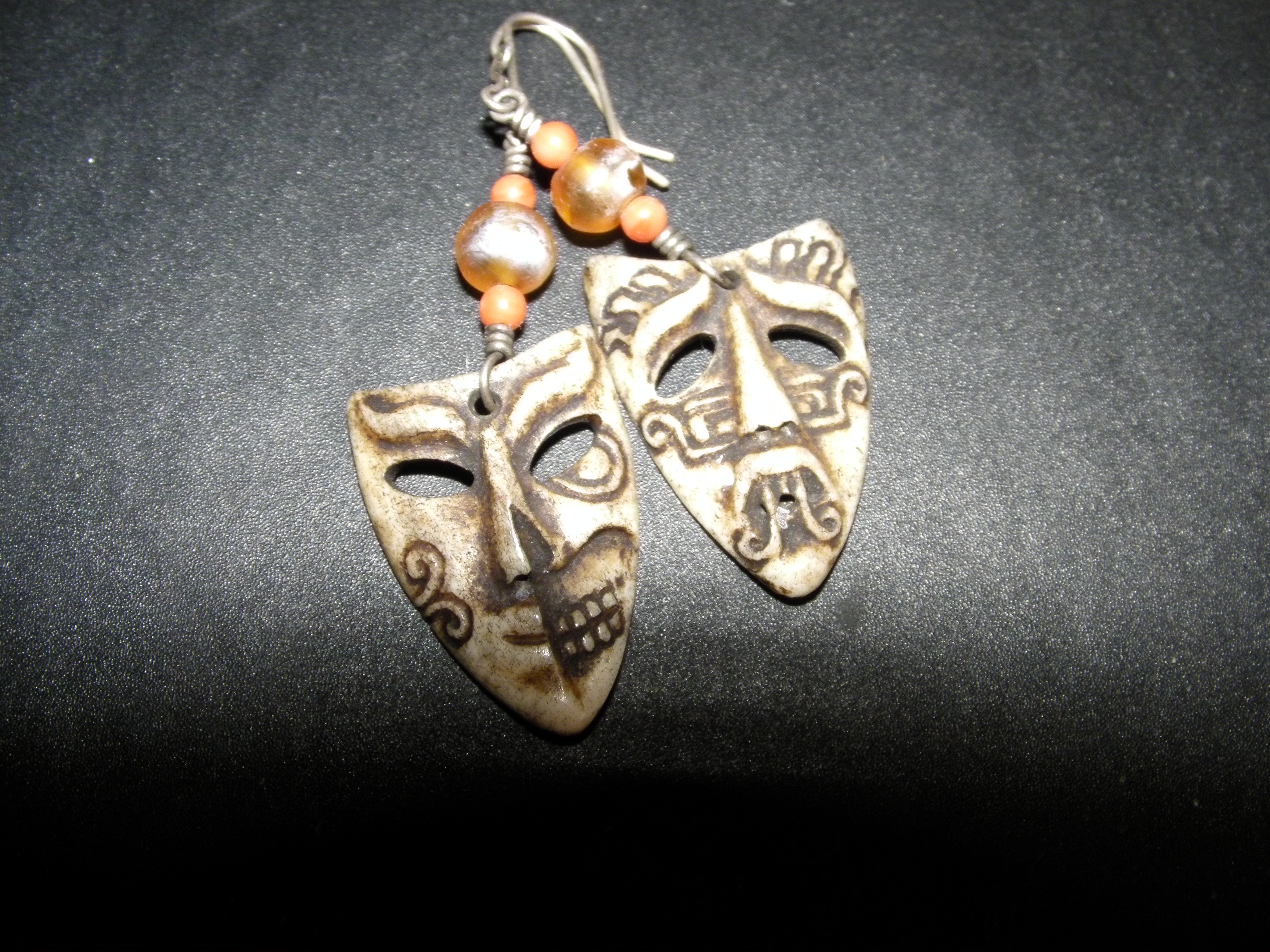
These earrings personify the bipolar experience for me. When I am manic, I am like the skeletor face and when I am depressed I am the personification of the drooping mask…even though we are required to wear masks in our day-to-day life I don’t know about you, but it is nearly impossible for me to wear a happy face in all arenas.
For the longest time I was reluctant to wear these earrings because I thought they were too weird and Aztec pagan, but recently I realized they are the perfect expression of my personality. Someone from outside could look at these and think they are weird or cool. But no one but myself will know what they truly signify. And I don’t know about you but sadly being bipolar is part of my identity.
I think, from DBT class and a lot of other blogs, that bipolar shouldn’t define a person. You can use your social and behavioral skills to mask it and not rock the boat for anyone else. But, right or wrong, being bipolar is part of who I am. I cannot escape from this, no matter how acceptably I behave; no matter what positive philosophy I adopt.
And I truly do believe that these positive philosophies are the way to go. Bipolar DOES NOT own you. But for my part, though it doesn’t own me, it is still a part of who I am and I do get sick of all the “positivity” and “cheerleading”. Does that make me a person who gives up? I don’t think so. Being aware is OK. It keeps a person ready to think a moment before reacting to something.
Because you are aware. Awareness isn’t a failing. Acknowledgement is not a failing. Acknowledgement is important and really the best way to help yourself.
Acknowledgement is not the same thing as characterizing oneself. I have been guilty of this. Acknowledgement does not give the disorder its power. Its power comes from characterizing yourself.
You are more than your bipolar disorder. But acknowledging it, even gaining personal power from the knowledge and experience, are good things, in my opinion as a person who has struggled with self-hatred and inferiority from this disease.
So I do like my earrings. They don’t mean the same thing to everyone.






 Siege of the Spirit