Folk don’t want the messy truth. Not that I have seen, at least not my messy truth. They want uplifting tales of hope, poignant tales of sorrow, struggle and overcoming into victory and joy that carries them up with it, and a shiny list of tools to get there. I can’t offer that.
I remain trapped in the journey. I slog along in a morass of something beneath evolved, thrashing in some sort of swamp with no enlightened path shedding a glow of epiphany through the sagging webwork of moss and spiderwebs that is my mind. I present my sense of hopelessness.
There was a bridge over it for a while, a stable earthen construction bordered by smooth logs, lifting the pilgrim over the marsh but not too high, following the vagaries of life but not dropping too low, and it seemed worthwhile to try to be a better person because it appeared possible. But the things chased me, the memories, mistakes, all I’ve done wrong, the shame, and they wouldn’t stop. The earthwork ended, and I fell straight in. Now the things have me again. They surge behind, around and in front, darkening my mind, eroding my thought and eating the hopes and the goals in front of me. They are monsters that chew, swallow and dissolve my lessons and my resolutions without cease.
In 2001 the people in my life suffered my psychosis, which lasted years. At the end of it I was exiled. I was expected to be ashamed of and accept responsibility for behaviors I could not control but only scream at from a tiny cage in my mind as I watched in horror. I was/am so sorry for the lives that I affected in such bad ways. I was/am ashamed, too, but I couldn’t let go of the idea that I was sick and that it was so unfair to be judged for having a disease. I very much wished I was dying of cancer instead of going around with the Sword of Suicide dangling over my head. People would sit at my bedside and call me brave for surviving as long as I had. Instead they spit on me, and if I’d succumbed to my illness they would have spit on my grave. My attempts to make amends were laced with bitterness and, justifiably, every one was refused. The worst part is, nowadays when I have a relapse episode, the self-loathing and bitterness return. How self-centered it all is. The mixed episodes have been returning with greater frequency, the brain fog is overwhelming, and now I’m in crisis again, which has not happened to me in a very long time. Hence this post, probably.
Here is what I am doing. DBT tool: mindfulness. DBT tool: Opposite action. Other tools: Masking, since it seems to be the only way to get along. Focusing on gratitude, gratitude, gratitude. Lifting other people up and cheering them on whenever possible. Forcing myself to go outside and play.
Most of these things have worked for a while but are now falling apart.
So for today, I have no tidy conclusion. I was trying to write things with tidy conclusions but that made me quit writing altogether. It was no more than a feeble attempt at masking anyway, only on the page. Then I tried writing my messy truth and no one wanted it. But that’s okay. Why should they?
Authenticity all the way.
My wish for you is that you are secure in the knowledge that you are valuable, no matter how you feel. Have a wonderful day.
I’ve found there have been an unusual amount of visitors lately, which is delightful and I’m very grateful! And I’m sorry there’s not much here that’s new.
Historically, I’ve been largely writing into the void. I took a long break from any writing at all—a break that spanned years, some of them quite difficult. As I’ve returned to writing, this site has been pretty quiet and the unfortunate consequence of this is that it got sidelined in favor of other backed-up projects.
The return to writing – mainly pertaining to the characters in my fantasy mythos but other things as well – was either the trigger for my bipolar episodes to resume or the reaction to their theatrical resurgence. Honestly, I’m still trying to figure this one out.
I missed the guys so much, especially Rushak. Once they reappeared, I was both overjoyed and apprehensive. And they brought friends! With weird symbionts! I just can’t trust my psyche. I didn’t know what was going to happen. Hypomania, crushing depression, paranoia … It’s effin’ rocky. Now that I’ve got years behind me, I understand stuff, though, and am piecing together what it means.
There are aspects of this journey I very much want to share in the hope they might resonate and offer comfort, ideas or help of some kind.
I have a lot of ideas brewing once more, challenges and solutions to explore, and I will be throwing a lot more effort into posting material with relevance and at least a semblance of consistency.
Upcoming topics:
Fear of failure
Victory
And probably related fiction and/or poetry (oh joy)
So, thank for visiting, for being here, and I hope to see you again.
Today’s offering is a flash fiction story about feelings.
Difficult feelings, painful to acknowledge feelings, painful to process and face.
Samhain
A.C. Turek
I sit with Gail under a large oak tree near the sword booth. She twirls a red-slathered autumn leaf by its stem.
“Have you ever seen a leaf this huge?”
“It feels like we’re sitting in another Samhain cliché,” I say. “The fair, the witches, the pumpkins and squash.”
“Yeah,” she agrees. “But for it to be a real cliché we’d have to get pomegranates and start setting out pictures of William Blake.”
I shift. “He’d like that except, there’s no trace of his spirit.” I’m not speaking of William Blake.
Gail looks down at her leaf, then up again, through narrowed eyes. “Maybe all that talking about it chased it away, or blocked your perception.”
That was not me. I’ve been stabbed. What the hell do you mean?
I said nothing at his funeral, and I should have. It’s a regret. Another knife-twist.
“I’m still so mad at him!” Gail says. “Selfish asshole.” She gets to her feet, limned in the green-gold sunlight. She gestures to the archers on the field. “I’ve gotta go hang with the boys.” With that she takes off, leaving me alone, my grief rekindled.
I sit here, staring through the bent bows, finely drawn silhouettes against deep blue sky. Death by suicide is not what people say it is.
A guy says something, chain mail glitters; Gail’s signature giggle strafes the field. It’s all very purposeful. A collarless dog runs past, brindled and skinny, barking after something. I push myself up to follow it, to find my own purpose, any purpose. I might have taken his dog, had I stood forward and offered. Had my offer had any chance of acknowledgement.
Two costumed knaves balance on a big log stretched across the irrigation canal, sparring with staves. Thick wheat grass cushions either end. A pony cart passes by, obscuring the contest for a few moments. The pony wears fairy wings, and the driver beams beneath her crown while a camera clicks all over them. It’s that literary dude with the long, gray ponytail, from the newspaper. The dog trots toward the pony, then thinks better of it.
A small commotion ensues at the balancing log. Laughter, rude words, clapping. The smaller man has fallen. His moccasined feet are sticking up out of the ditch, bicycling the air.
I realign myself with the dirt track ahead of me. It leads off toward the alley, edged by a weed-footed chain link fence. A faded wrapper hangs in a thistle. The air is flat and stale, and the dog has disappeared.
What comes first, I don’t know. Depression from helplessness, or helplessness from depression; I think there are arguments for both.
First off, I’m not a psychologist, and have no academic qualifications to address any psychological disorder. I haven’t done extensive research and have no scholarly citations to list at the end of this. I do not claim to have the empirically correct solution. I’m just here to share things that, through trial and error, ended up working for me after I lost practically everything to bipolar 1 mania and depression, and I learned helplessness.
When bad things that are out of your control keep happening to you, you eventually come to believe that things cannot get better and there’s nothing you can do to improve your situation or your outcome. Whatever you try leads to no escape and that is the law of your life.
People with learned helplessness lose their motivation, and just get washed along with the current, expecting they will end up in the swamp or the quicksand and sink. There is no point in trying to save themselves. They become hopeless, and even anticipate more bad things. Helplessess is the law of their life.
“Let go of what you can’t control and choose to be positive” is not a helpful piece of advice to someone in this state, so you just have to blow off people who scorn you for not being able to do it.
This quote (somebody threw in my face) from the Greek Stoic philosopher Epictetus is what got me to pondering on helplessness:
“Freedom is the only worthy goal in life. It is won by disregarding things that lie beyond our control.”
Okay. If you buy this, it looks like to win freedom from whatever, you just choose to ignore the things you can’t control, because if you disregard the things, they can’t control you. But it’s not that simple if you’re in a morass of learned helplessness and depression.
Don’t you at least have to acknowledge the things that are beyond your control? Will it really help you, avoiding thinking them over? What is actually going on? Is there a cause? If the cause is something you can’t control, ignoring that cause isn’t going to keep it from controlling you. Looking at it is the only way to begin to understand it.
To find freedom you must first accept the feeling or circumstance. Ignoring is just a way to put off acceptance, and therefore the power of change. One day, look at the circumstance objectively, and look at everything surrounding that one uncontrollable situation. Look at how it is affecting you. This can lead you to find something to change about yourself. Find something you can control. You can’t do that by disregarding the thing you can’t control.
Once you acknowledge and accept the thing that is out of your control, you can move toward finding a strategy to empower yourself.
Steps to self-empowerment:
They say you can control your attitude. Just snap your fingers and CHOOSE to be positive!
Okay, well, that doesn’t work for everyone. I suggest mindfulness as a starting point.
Mindfulness helps you to ground yourself in the moment. Feel the surface under your hand. What do you hear, see, smell? Label it. Describe everything to yourself. Even if you have to actually slam your hand down on the table and say “table!” Knowing where you are and what is around you is the beginning of control. It’s the beginning of viewing yourself and events objectively.
Your approach to the circumstances. Consider approaching the challenges differently (or at all).
One way is to try looking at your situation as containing a problem to be solved. You can make a shift from helpless complacency to being solution-oriented. This doesn’t mean you can control an uncontrollable circumstance such as weather or how someone else is acting, but you may have control over an effect or two on your environment or your frazzled brain. If you can’t spring immediately into a positive attitude toward things, still you can choose what action you take. If you can pick up one little aspect of your life and improve it, do it, and be mindful of that improvement, even if it’s just managing a smile or putting away a cup. Don’t belittle it or yourself. Don’t feel you have to put more effort into it than you can at the moment. As you get stronger, you’ll be able to put more effort in, and your attitude will improve. One little step at a time, you can progress into a solution-oriented attitude by focusing on those tiny adjustments, the things you can control.
Don’t forget to take care of yourself. Prioritize your physical and mental health.
This is another big topic in and of itself. You can’t take care of the helplessness as effectively if you don’t take care of yourself. The hardest thing can be taking the time for it. If you’re not in the habit of taking care of yourself, it’s looking like another big, overwhelming project. It doesn’t mean you have to embrace diet, fitness, sleep, and social time. You can find one thing at a time to improve. You might break it down, make a list, choose the first small thing you can do for your health that you haven’t taken the time to do.
Allow people to help you.
This is a tough one for some people, independence, bootstraps and all that. You can choose to accept help or not. But if you can’t accept help, you could be making the hill you must climb that much higher and steeper. I have little to contribute to the general idea, because it was difficult for me, but I know I usually made things a lot more difficult when I refused help.
Attend to relationships.
Do your best to nurture what you have with family, friends, coworkers. Find ways to reach out. Let them know they are loved and appreciated. Examine those relationships (objectively, as above, if problematic) and work on improving them in any way that is relevant to your situation.
A personal story of how I empowered myself
During a time of poverty that seemed so hopeless that I lost all motivation to care for myself or my surroundings, I got into the danger zone. My husband couldn’t find work, and when he did his clients took advantage of him. I was disabled due to severe bipolar episodes. I felt helpless to fight the disease. And I was sure we were destined to lose our home. There was no point in cleaning house, because it was too overwhelming. There was only so much we could do to maintain the place with no money, despite my husband’s skills. Furniture was left outside, and though I didn’t want it there, it was there, so there was nothing to be done about it. There was no point in trying to communicate with my family, because I was a bad mother, a worse wife, and there was no understanding between us. And so on. Little things and big things sticking together and rolling along, into a boulder of hopelessness. I was helpless. I knew I was powerless to effect any positive outcome, so I didn’t try.
One day I looked at a table that had been left outside, and it was damaged, and for some reason I picked it up and moved it. I have no words to describe what a big achievement that was. But that was the beginning. I learned that it didn’t have to stay where it was. Yes, it was neglected, but just because it was outside did not mean it was already too late for it. I could stop further damage because I had the power to move it. Wow.
It was not the thing that lifted us out of poverty, but it was an event that began my slow journey out of helplessness, which eventually became part of the greater process of ending the poverty. Despite the large proportion of circumstances that were out of my control, there were things that could be controlled, and it was a matter of teaching myself that I had the power to control them. Somehow, over time, one teeny thing after another, I able-ized myself.
It’s finally over. February. Having worked its foul, soul-crushing necromancy, as February always does, springlike weather notwithstanding, and launched me into March madness. Let the rapid cycling commence: Mania’s mental modifications to depression’s non-functionality, swapping every 24-72 hours, despite medication adjustments.
So … writing with bipolar. It seldom ends well for the characters. Pain and creativity go hand-in-hand with us, and we’re navigating these talus field crossings as best we can, but the process can be difficult. The main character/protagonist becomes the whipping being for all the angst their creator would otherwise expend upon herself. (Not that there isn’t plenty of damage left to be done once MC’s wrung out.)
The main thing I feel during rapid cycling is helplessness. The creative outlet for this is the writing, the story, my suffering hero, Rushak. He is swept along through the tempest, up, down and through, as my moods carry him (given the opportunity to write). My feelings of helplessness during these times are the main contributors to his lack of agency at various points in the story. Rush makes a decisive move, and lands afterward in a place of helplessness, and has a terrible floundering time getting out of it alone, if he even can. In an alternative universe, on a separate world, Lohar abides. He usually dies.
Hail to the suffering hero. Depression or mixed state is the time of his great helplessness, whether the scenes will end up in the book or not. If there is violence in me it will be wreaked upon him, or result in self-harm. Without him, I’m not certain I’d be alive.
January is Mental Wellness Month, and also this month, it’s expected we welcome the new year with resolutions and then at least pretend to try to enact them. Resolutions can be thought of as promises to make personal change for the better, so it’s a perfect time to focus on mental well-being.
One of the biggest things we can do for ourselves is get regular exercise, right? The National Institute of Health says that just 30 minutes a day of mere walking can improve mood, reduce stress and, of course, provide a host of health benefits. Taking that walk in natural sunlight will even help us connect with that elusive unicorn known as “sleep.”
In the winter, especially, enjoying what sunlight is available is an important component of managing depression and mood swings, bipolar and otherwise.
I don’t know about you, but for me it’s so hard to get out when I’m depressed. Nice, helpful articles with bullet points generally have “Participate in favorite activities,” “Go out in nature,” and “Get enough sleep,” in them. But uh, it’s gray outside, it’s cold, I feel shitty, there’s no snow, I have to work tomorrow, everyone hates me, I hate everything, I can’t get enough sleep ’cause reasons, and, oh yeah, what “favorite activities?” Are you storming kidding me?
My modus operandi is to take a plan, any plan, and find one good excuse to jettison it so I can go sit and not write and stare at the dusty piano and feel sorry for myself.
So, in the name of self-preservation, it’s time to force myself to help myself against my will. Does this sound familiar? It’s sooooo hard! Exercise and sunlight are the topics for this Sunday, and a wan, winter sunlight it will be. How to get there:
I have learned to mechanically program my body to do the things to prepare for the activity, “just in case I change my mind.” Perform tasks, be the automaton, just like at work. Task A, B, C. Miserably put on clothes, drink coffee, eat breakfast, doggedly put on shoes and tie laces in spite of cat helping, and then … the danger point … go back to pee and look for phone.
Once past that, shove the body out of the door with will alone, and … outside. Having someone pushing helps.
I’m still depressed, though, and not having fun, because I’m depressed, and depression is tenacious as a headache. But you know what? Feeling the warmth on my face, the light on my eyelids, watching the solid tranquility of twisted junipers with the breeze whishing through them, hearing good music or clattering freight trains … I’m not enjoying it. I don’t want to be here … the energy is just soaking into the body and brain without me. The sights, sounds, and smells are ambling right in through the eyes, ears, and nose into the “animal hindbrain.” I think about that objectively, how I’m mad, but that’s not stopping the sunlight from penetrating or the images of my surroundings from imprinting themselves.
This involuntary absorption of healing influences is a thing. It will do its job. Going outside for sun and exercise does result in reduced stress, stabilized or elevated mood, increased energy, and better sleep. But yes, sometimes, it has to be forced.
Losing focus . . . it’s the first sign of change for the worse. It means that I am either stepping up from hypomania into irritable disorientation and rage, or slipping down into useless depression. It doesn’t take me long to figure out which. And the feeling of losing focus, where I’ve been, along with being stuck in a debilitating fatigue, is a terrible thing.
Losing focus is trying to grasp a tendril of smoke that was something else when I reached.
searching among fragmented paths for a way home
fermented clouds soaking the brain
plucking at harp strings of dry wool
bird bashing head against green-glass walls, and frenetic wings continue flapping
slinky nooses around a mind of gleaming burlap in the night
So, medical procedures coming up. Over and over again, I get tested for various conditions (seldom the same ones) in the hope there’s a treatable explanation for some of my problems. There’s never an answer “Oh yes, you have X,” on these tests, which one should think is great, because I don’t have any of the things wrong. So we’re back to: Yes, bipolar. Yes, clinical depression. But do they explain everything? REALLY? Huh?
My doctor’s got an answer for me every time.
“We’re all getting old.”
Well good for her. She can afford to retire.
OK, this time, her answer was a phone call with test results that were a disturbing list of things that need follow-up. OK, self. Are you satisfied yet? Well, let’s see what happens. In the meantime, I’ll bust out the mood chart and what.
Some days, I can’t see a way forward. This is one of those days. Climate is stressful. Future uncertain. I can’t bear the thought of going to work. I’m afraid of losing my job. I don’t know why, and I don’t know how long I can hang on. I need change.
What to do, what to do. Call my provider’s crisis line? My self-esteem is too low to consider wasting their time.
When this happens, I have a hard time finding the solution-oriented person I’ve learned to become after 50 years of this. So, grasping at straws, I bang my way through piano music, making it up on the spot sometimes, almost invariably some repetitive doom-laden lacrimose storm front in the key of A minor. I update my Linkedin in the hope of finding some sort of freelance work in case the worst-case scenario comes to pass, and everything in my profile looks amateur and stupid. I immerse myself in tasks around the house that are normally satisfying, but I’m still hyperventilating.
When these feelings overwhelm, I can’t help worrying. I can’t help worrying that I’m relapsing. This feels like a mixed-manic shitshow.
And watching the world around me, it seems evident that I’m not alone, that this is nothing special. But your life matters. Go ahead and call the crisis line, if you are in my boat.
National Suicide Prevention Lifeline: 800-273-TALK (8255)
I have moved to the floor out of respect for an older woman who has arrived, a friend of the hostess. The cool of the brown carpet chills me, though at my back the woodstove throws heat which rises up and over me. The long, lustrous brown table, cluttered with fruit and nuts and wine and books and breads and beer, separates me from the man who brought me here. He is sprawled upon the couch opposite, the only male among the gathered poets, the whites of his eyes glowing between the dark curls of his hair and the bushy mustache, darker still.
I look around at the assembly, women all, of every age and description. Some are old and well-read, some seasoned writers; the young ones bring imagination instead of experience to their art. The smell of their wine is something I cannot escape, acute and heady like strong scented flowers. It makes me slightly dizzy.
I have not been to a gathering like this in too many years. Farm life has dulled the edge of my wit. Happiness and acceptance have made me a poor critic. I cannot impress these people, I think, nor even present myself as worthy to be among them.
It has been a long time since I gathered up words like branches and tossed them into huge, tousled piles for the sheer joy of their design, their many textures and shapes making a rat’s nest of forms and colors: iridescent purples, shrieking magentas, dried-out grays, with knobby joints like an old man’s knuckles, or skewer ends sticking out everywhere.
The young girl, who feels the need to clarify that she is not a Rastafarian—perhaps because of her vivid sweater of yellow and orange and green and red—heaves words together with luxurious abandon, bathing herself in in the sound and flash of light, in a glory of enthusiasm and innocence. They mean almost nothing to me, but the sensory experience of them thrills. She belongs here, with the word artists.
The older women, with their carefully written lines, convey in images and strong voices ideas so well-formed that I feel inarticulate. Ideas spark more ideas, criticisms spark inspirations, agreements, disagreements, leaving everyone full and helped. I say little.
Oh, I am keenly interested, but am rendered wordless. I am inspired, but I don’t belong. I write “that stuff–no offense.” I know long before my turn arrives that my visions have no place here. I would like to transcend my genre, but I feel I have to apologize for it. I feel like I need to defend it. I feel like these narrow-minded scholars could benefit so very much from fantasy, if they would only listen.
Like in Amadeus, “too many notes” becomes the accusation against me, but I laugh it off. I know there is a tendency in my work towards abundant description. I am not defensive about it. When I finish, they exclaim and clap.
When can I read this book? What happens, what does he do with the infant?
He names it, of course. If he doesn’t there would be no story, Karla observes. Karla is no dummy.
And here I am, explaining it. Alice wants to know how I can write that stuff. “This came to me when I was only ten, that is why it is the way it is. I write it because I have to.” Why do I write that stuff? “If I don’t, I go crazy.” Natural answers to reasonable questions.
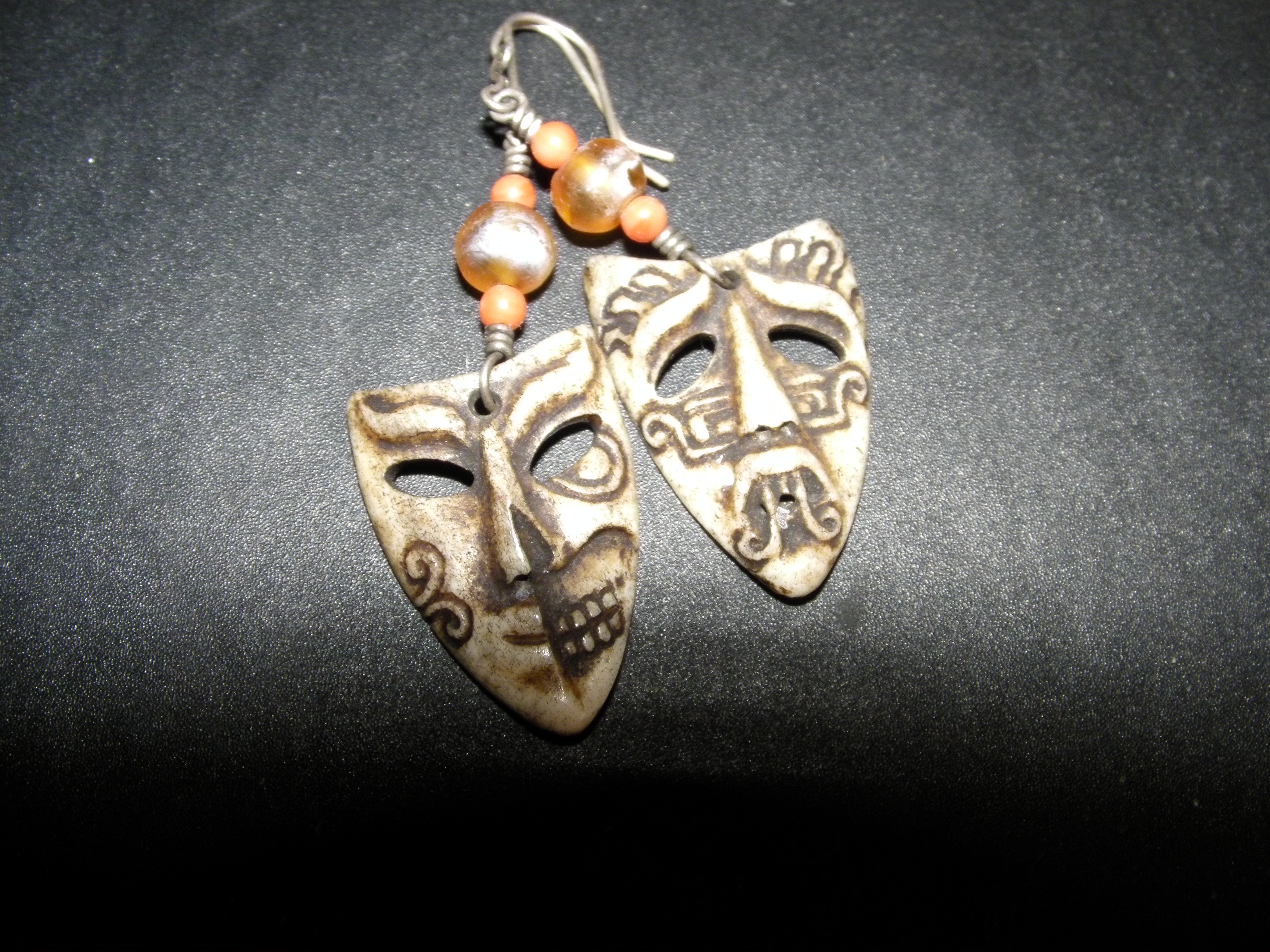
These earrings personify the bipolar experience for me. When I am manic, I am like the skeletor face and when I am depressed I am the personification of the drooping mask…even though we are required to wear masks in our day-to-day life I don’t know about you, but it is nearly impossible for me to wear a happy face in all arenas.
For the longest time I was reluctant to wear these earrings because I thought they were too weird and Aztec pagan, but recently I realized they are the perfect expression of my personality. Someone from outside could look at these and think they are weird or cool. But no one but myself will know what they truly signify. And I don’t know about you but sadly being bipolar is part of my identity.
I think, from DBT class and a lot of other blogs, that bipolar shouldn’t define a person. You can use your social and behavioral skills to mask it and not rock the boat for anyone else. But, right or wrong, being bipolar is part of who I am. I cannot escape from this, no matter how acceptably I behave; no matter what positive philosophy I adopt.
And I truly do believe that these positive philosophies are the way to go. Bipolar DOES NOT own you. But for my part, though it doesn’t own me, it is still a part of who I am and I do get sick of all the “positivity” and “cheerleading”. Does that make me a person who gives up? I don’t think so. Being aware is OK. It keeps a person ready to think a moment before reacting to something.
Because you are aware. Awareness isn’t a failing. Acknowledgement is not a failing. Acknowledgement is important and really the best way to help yourself.
Acknowledgement is not the same thing as characterizing oneself. I have been guilty of this. Acknowledgement does not give the disorder its power. Its power comes from characterizing yourself.
You are more than your bipolar disorder. But acknowledging it, even gaining personal power from the knowledge and experience, are good things, in my opinion as a person who has struggled with self-hatred and inferiority from this disease.
So I do like my earrings. They don’t mean the same thing to everyone.






 Siege of the Spirit