Skip navigation

Tag Archives: fantasy

I’ve found there have been an unusual amount of visitors lately, which is delightful and I’m very grateful! And I’m sorry there’s not much here that’s new.

Historically, I’ve been largely writing into the void. I took a long break from any writing at all—a break that spanned years, some of them quite difficult. As I’ve returned to writing, this site has been pretty quiet and the unfortunate consequence of this is that it got sidelined in favor of other backed-up projects.

The return to writing – mainly pertaining to the characters in my fantasy mythos but other things as well – was either the trigger for my bipolar episodes to resume or the reaction to their theatrical resurgence. Honestly, I’m still trying to figure this one out.

I missed the guys so much, especially Rushak. Once they reappeared, I was both overjoyed and apprehensive. And they brought friends! With weird symbionts! I just can’t trust my psyche. I didn’t know what was going to happen. Hypomania, crushing depression, paranoia … It’s effin’ rocky. Now that I’ve got years behind me, I understand stuff, though, and am piecing together what it means.

There are aspects of this journey I very much want to share in the hope they might resonate and offer comfort, ideas or help of some kind.

I have a lot of ideas brewing once more, challenges and solutions to explore, and I will be throwing a lot more effort into posting material with relevance and at least a semblance of consistency.

Upcoming topics:

Fear of failure

Victory

And probably related fiction and/or poetry (oh joy)

So, thank for visiting, for being here, and I hope to see you again.

Rushak as a Tree

Image: Twisted leaning pinon snag with juniper behind in the gloaming

Image: Rushak as a tree

It’s finally over. February. Having worked its foul, soul-crushing necromancy, as February always does, springlike weather notwithstanding, and launched me into March madness. Let the rapid cycling commence: Mania’s mental modifications to depression’s non-functionality, swapping every 24-72 hours, despite medication adjustments.

So … writing with bipolar. It seldom ends well for the characters. Pain and creativity go hand-in-hand with us, and we’re navigating these talus field crossings as best we can, but the process can be difficult. The main character/protagonist becomes the whipping being for all the angst their creator would otherwise expend upon herself. (Not that there isn’t plenty of damage left to be done once MC’s wrung out.)

The main thing I feel during rapid cycling is helplessness. The creative outlet for this is the writing, the story, my suffering hero, Rushak. He is swept along through the tempest, up, down and through, as my moods carry him (given the opportunity to write). My feelings of helplessness during these times are the main contributors to his lack of agency at various points in the story. Rush makes a decisive move, and lands afterward in a place of helplessness, and has a terrible floundering time getting out of it alone, if he even can. In an alternative universe, on a separate world, Lohar abides. He usually dies.

Hail to the suffering hero. Depression or mixed state is the time of his great helplessness, whether the scenes will end up in the book or not. If there is violence in me it will be wreaked upon him, or result in self-harm. Without him, I’m not certain I’d be alive.

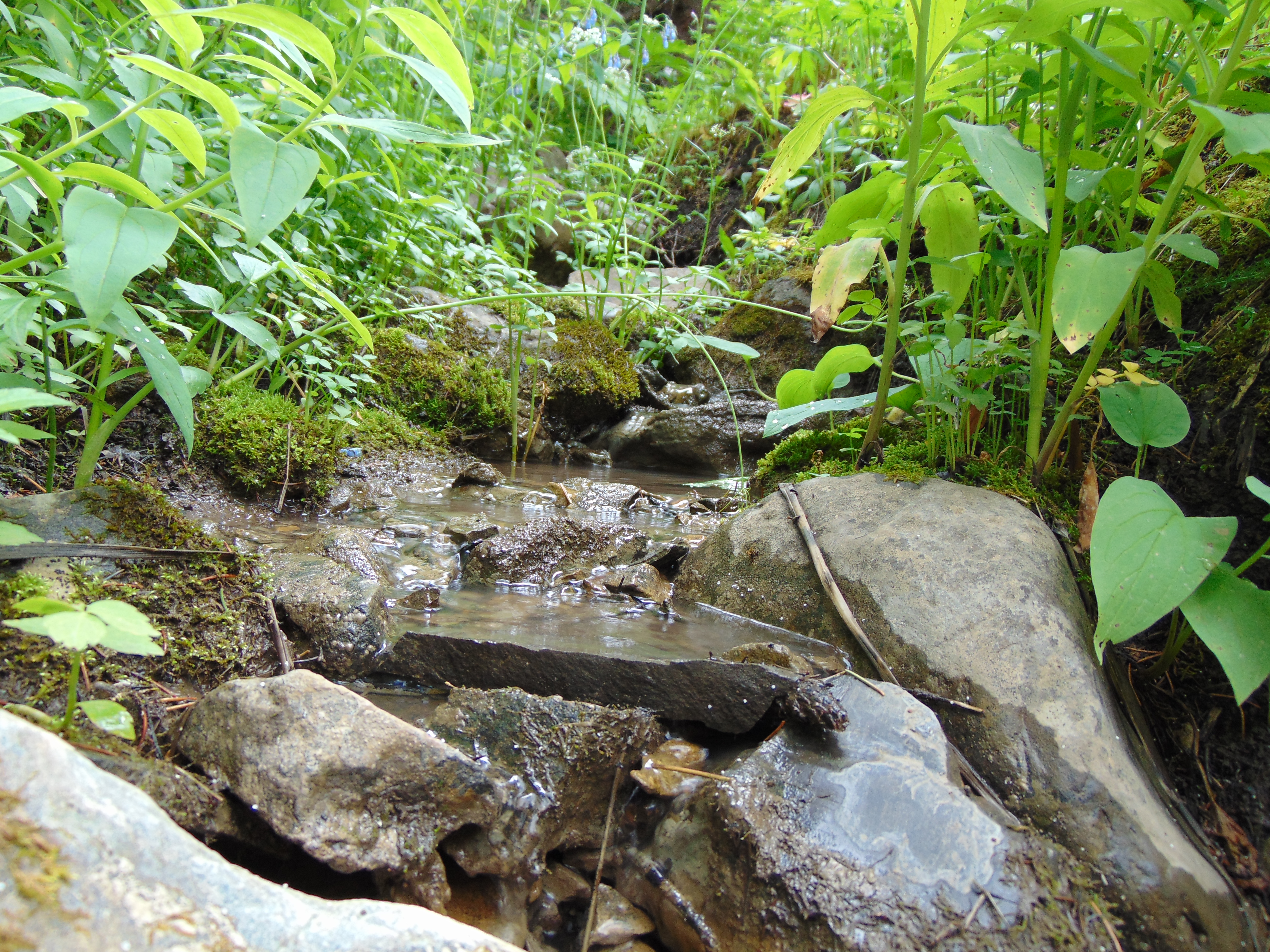
The river had dwindled to a series of pools connected by grassy land bridges full of wildflowers, broadleaf plants and blooming bushes. Each pool wore a different aspect. Most seemed clean and empty of thought, their blank surfaces rippling with each changing breeze. In some, a smoky murk obscured the depths in a fog of slow, swirling rumination. One sulked in stagnation and decay, releasing putrid-smelling bubbles. He happened on one pool that seemed to smile. Clear and shallow, it sprouted reeds and watercress. Pollywogs swam there, some small and lithe, others fat as toads, and all had hind legs. They clung to the reeds; their translucent, vibrating tails stirred tiny currents.

One of the pools, an inscrutable, impenetrably deep one, made a home for gigantic trout.

It was from this one, with what could only be a blessing from Iryla, that he was able to snare his supper. Yet it was this same pool, dark and sheltered, the greenery drooping over its banks, that stymied him, barring him from hard-won peace. For it was this pool that looked the most familiar. It was the image of the pool inside him, and he wanted to fling himself there and drown. The cool pool of despair. That it should be the pool to feed him was not even an irony, for was it not his despair sustained him? It was his despair that kept him sane on this walk through a life in which hope would be madness. He tried to share the thought with Drisal, but it only made his brother sad. He should have known this. For he was alone. Aershmela would mock such a sentiment. Cerel would have no patience for it, because he could not understand. Lara would listen and comprehend, but then she would argue with him that he did have hope, that hope was in the Duality, and that faith and hope would save him.

Only Theris would truly understand. Only Theris would not judge the observation as self-pitying. Only Theris would not try to fix it as Lara did; and only Theris would see the point of it without Drisal’s capacity to be hurt by what he saw.

He smiled, thinking of Theris, thinking that whenever he needed to talk to someone he could talk to his memory.

The fish was good. The breeze was gentle and the twisted roots beneath which he passed the night promised him no discovery.

I have moved to the floor out of respect for an older woman who has arrived, a friend of the hostess. The cool of the brown carpet chills me, though at my back the woodstove throws heat which rises up and over me. The long, lustrous brown table, cluttered with fruit and nuts and wine and books and breads and beer, separates me from the man who brought me here. He is sprawled upon the couch opposite, the only male among the gathered poets, the whites of his eyes glowing between the dark curls of his hair and the bushy mustache, darker still.

I look around at the assembly, women all, of every age and description. Some are old and well-read, some seasoned writers; the young ones bring imagination instead of experience to their art. The smell of their wine is something I cannot escape, acute and heady like strong scented flowers. It makes me slightly dizzy.

I have not been to a gathering like this in too many years. Farm life has dulled the edge of my wit. Happiness and acceptance have made me a poor critic. I cannot impress these people, I think, nor even present myself as worthy to be among them.

It has been a long time since I gathered up words like branches and tossed them into huge, tousled piles for the sheer joy of their design, their many textures and shapes making a rat’s nest of forms and colors: iridescent purples, shrieking magentas, dried-out grays, with knobby joints like an old man’s knuckles, or skewer ends sticking out everywhere.

The young girl, who feels the need to clarify that she is not a Rastafarian—perhaps because of her vivid sweater of yellow and orange and green and red—heaves words together with luxurious abandon, bathing herself in in the sound and flash of light, in a glory of enthusiasm and innocence. They mean almost nothing to me, but the sensory experience of them thrills. She belongs here, with the word artists.

The older women, with their carefully written lines, convey in images and strong voices ideas so well-formed that I feel inarticulate. Ideas spark more ideas, criticisms spark inspirations, agreements, disagreements, leaving everyone full and helped. I say little.

Oh, I am keenly interested, but am rendered wordless. I am inspired, but I don’t belong. I write “that stuff–no offense.” I know long before my turn arrives that my visions have no place here. I would like to transcend my genre, but I feel I have to apologize for it. I feel like I need to defend it. I feel like these narrow-minded scholars could benefit so very much from fantasy, if they would only listen.

Like in Amadeus, “too many notes” becomes the accusation against me, but I laugh it off. I know there is a tendency in my work towards abundant description. I am not defensive about it. When I finish, they exclaim and clap.

When can I read this book? What happens, what does he do with the infant?

He names it, of course. If he doesn’t there would be no story, Karla observes. Karla is no dummy.

And here I am, explaining it. Alice wants to know how I can write that stuff. “This came to me when I was only ten, that is why it is the way it is. I write it because I have to.” Why do I write that stuff? “If I don’t, I go crazy.” Natural answers to reasonable questions.

That stuff. The label that sticks.

A loud thump startled him out of sleep. Not loud enough to relieve the darkness of his dreams with waking fears, but more to give a kind of substance to their stalking, nameless shapes. A sound of heavy treading, a clomp upon a stair.

He tensed, his heart beginning to race, but the sound faded even as he sought to identify it.

It was gone. No one had come. It mattered little. He had nothing to offer.

He began to drift, downward, deeper, beneath the sightless rock pools to shelter from the shadow walkers. They circled him, and began to merge. He smelled the dank green moss beneath his hands. He felt the cool breath of the beginnings of despair. And the sound came again, this time with a shriek, and a roar that drowned all dreaming.

It was the wind, he realized, coming awake, a storm wind lurching in fierce gusts from across forever. It beat the crumbling keep with angry fists, careened shrieking around corners and through cracks in the stone, roared overhead like a great beast with a cymbal-crash of battering wings.

A moment of respite, a settling, and then another gust slammed the wall, crushing the mortar like an enormous boulder from God’s own catapult, if such a thing could exist.

The surface against which he pressed himself, he could feel it shake, and heard a quiet voice nearby, almost a whisper, as if in prayer.

He thought himself awake at last, but the darkness remained as it had been. Except for the shadow stalker, which had either vanished or come fully upon him, in tides of pressure that squeezed and bent and twisted him, to flatten, mold or break him; unrelenting as the wind in all its myriad shapes.

All that sound, compressed in his head. Wind crashing skirl…silence.

No sound of whispered prayer. No one there, at all.

Only a grating and grinding behind his heart, the swells of wind, and the cancerous pressure of darkness.

Something about it…he had been here before. He had a decision to make, and quickly. To yield, or to fight it. To brace, or allow it to embrace and crush him.

But not to name it. Absolutely, no.

mgmasoncreative.wordpress.com/

Freelance writer and video editor, and indie author

Inventing Reality Editing Service

Professional, Affordable Book Editing

Hiria Dunning

kaituhi // author, playwright, game writer

Writer Beware

Shining a small, bright light in a wilderness of writing scams

Living with Intent

Liberate from convention and live with extraordinary intention

The Bipolar Dance

My journey from hell and back and back again with bipolar disorder

not enough tissues for issues

Something's got to give......

A Christian Overcomer

My Human Journey to God

Werner Nokota Horses

Bluebell Ranch Sweden

maggiemaeijustsaythis

through the darkness there is light

Spring Creek Basin Mustangs

Tracking the Wild Horses of Spring Creek Basin